Industry news, technical articles, and project insights from Solar Lighting International.
As coastal cities face stronger storms and longer power disruptions, Hurricane Resistant Solar Street Lights are becoming a practical resilience investment. NOAA’s 2024 Billion-Dollar Weather and Climate Disasters report recorded 27 U.S. disasters costing at least $1 billion each. Several involved hurricanes, flooding, or severe wind. These figures make outdoor lighting more than an energy-saving decision. It is also a public-safety and infrastructure-continuity issue.
The 2025 IRENA Renewable Capacity Statistics report shows that solar power remains the fastest-growing renewable technology worldwide. However, rapid deployment does not guarantee storm survival. A reliable solar street light needs more than a large panel and a bright LED. Engineers should examine wind-load calculations, pole foundation depth, battery enclosure protection, drainage, corrosion resistance, and replaceable components. IEC 60529 ingress-protection ratings and IEC 62262 impact classifications provide useful testing references, but ratings alone cannot prove hurricane performance. Local building codes and site-specific engineering still matter.
Field experience often reveals the weakest detail: a loose cable gland, exposed connector, or poorly anchored base. The best design on paper can fail there. Buyers should request test records, material specifications, warranty terms, and documented operating results from comparable coastal projects. NREL and international solar-industry research repeatedly emphasize performance verification, lifecycle reliability, and maintenance planning. Yet no product is invincible. That assumption is dangerous. This 2026 guide compares Hurricane Resistant Solar Street Lights through a practical lens, balancing illumination, autonomy, wind resistance, battery safety, installation quality, and long-term serviceability. A slightly conservative choice may outperform a cheaper system after one severe storm.
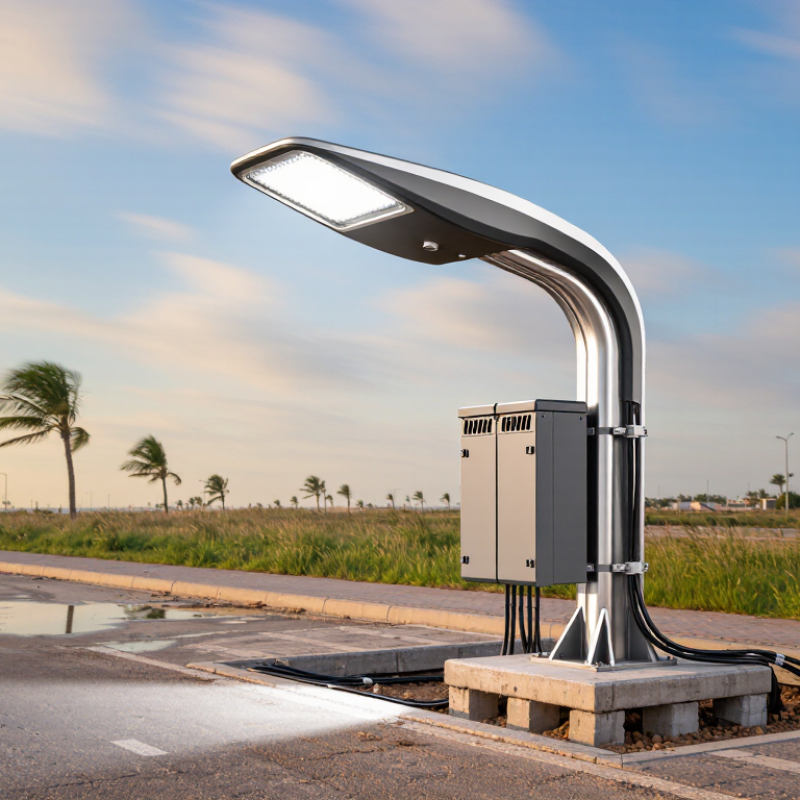
A hurricane-resistant solar street light begins with structural engineering, not a larger solar panel. The pole should match local wind-load calculations and use a deep, reinforced foundation. Strong anchor bolts matter too. A light can survive high winds only when the entire system works together.
The fixture needs a sealed housing, usually with high IP protection, to resist wind-driven rain and salt spray. Impact-resistant glass or polycarbonate helps prevent damage from flying debris. The solar panel should have a secure frame, rounded edges, and tested mounting points. Loose brackets become dangerous during violent gusts. Internal surge protection also reduces risks from nearby lightning.
Battery protection is easy to overlook. A ventilated, temperature-controlled enclosure can reduce heat stress and moisture damage. Corrosion-resistant fasteners are valuable in coastal streets. Regular inspections should check cracks, tilted panels, rust, loose bolts, and blocked drainage paths.
“Hurricane resistant” is not the same as hurricane proof. That distinction matters. Certification, wind-tunnel testing, and compliance with local construction codes provide stronger evidence than advertising language. In practice, maintenance quality can decide the outcome. Even a well-designed light may fail after neglected corrosion or an aging battery. A practical design review should question every connection, because small weaknesses often appear first.
2026 Best Hurricane Resistant Solar Street Lights?
Hurricane resistance begins with the structure, not the solar panel. Choose poles engineered for local wind loads under recognized standards such as ASCE 7 or equivalent national codes. The design should show exposure category, mounting height, projected area, and safety factors. A wide, reinforced base helps resist overturning on wet ground. Anchor bolts need corrosion protection and verified embedment depth. Bigger is not always stronger.
Weather resistance also requires clear enclosure ratings. Look for at least IP66 protection against dust and powerful water jets. An IK08 or higher impact rating helps protect the lamp housing from flying debris. Tempered or laminated glass can reduce damage after branch strikes. Salt-air locations need marine-grade coatings, sealed fasteners, and documented salt-spray testing. Galvanic corrosion between different metals remains an easy mistake.
The battery compartment deserves equal attention. It should limit water entry, control heat, and remain serviceable after storms. Lithium battery systems need protection against overcharging, deep discharge, and abnormal temperatures. Ask for test records covering vibration, UV exposure, humidity, and repeated thermal cycling. Field inspections often reveal loose brackets before laboratory ratings do. No standard removes every risk. A careful site survey still matters. Even excellent equipment can fail when drainage, soil strength, or maintenance access is ignored.
| Evaluation Dimension | Relevant 2026 Reference | Recommended Performance Target | What to Verify | Hurricane-Resistance Importance |
|---|---|---|---|---|
| Site Wind Design | ASCE/SEI 7-22 or the locally adopted structural code | Design for the project-specific basic wind speed, exposure category, risk category, topography, and directionality factors. Do not use one universal wind rating for every site. | Stamped structural calculations showing the design wind pressure, projected area, overturning moment, and load combinations. | This is the primary method for determining whether the pole, luminaire, solar module, and foundation can withstand hurricane winds. |
| Pole and Arm Strength | AASHTO LRFD Specifications for Structural Supports for Highway Signs, Luminaires, and Traffic Signals; local structural requirements | Pole, arm, base plate, welds, and connection bolts should be checked for combined bending, shear, torsion, fatigue, and serviceability loads. | Material certificates, wall-thickness records, weld inspection documents, and structural calculations for the complete assembly. | A strong luminaire cannot compensate for a pole or arm that is undersized or poorly connected. |
| Foundation and Anchoring | Site-specific geotechnical design; applicable building and foundation codes | Design for overturning, uplift, sliding, soil bearing capacity, groundwater, scour, and concrete breakout. Anchor bolts must match the calculated tension and shear loads. | Foundation drawings, concrete strength specification, rebar schedule, anchor-bolt grade, embedment depth, and soil assumptions. | Many storm failures originate in soil movement, anchor failure, or foundation overturning rather than in the light fixture. |
| Solar Module Mechanical Load | IEC 61215 series; applicable local wind and snow-load calculations | Use a module and mounting system whose certified mechanical-load capability is greater than the calculated site loads, including uplift and pressure reversals. | IEC 61215 test documentation, module load rating, clamp-zone requirements, mounting-angle calculation, and fastener details. | The panel is usually the largest exposed surface and can create significant uplift and overturning forces. |
| Luminaire Safety and Roadway Use | IEC 60598-1 and IEC 60598-2-3 | The complete road and street lighting assembly should comply with the applicable luminaire safety and roadway-lighting requirements. | Type-test reports, electrical safety documents, thermal tests, wiring diagrams, and photometric files. | Helps confirm that the fixture remains electrically and mechanically safe after exposure to severe outdoor conditions. |
| Ingress Protection | IEC 60529 | IP66 is a practical minimum target for the luminaire and controller enclosure in hurricane-prone coastal locations; higher protection may be selected where justified. | A valid IP test report for the complete enclosure, including cable glands, connectors, door seals, and drainage details. | IP66 indicates protection against dust ingress and powerful water jets; it does not certify wind strength or storm-surge immersion. |
| Impact Resistance | IEC 62262 | IK08 or IK10 for exposed housings and protective covers, subject to the project’s vandalism and flying-debris risk assessment. | Test report identifying the tested enclosure configuration and impact-energy level. | Improves resistance to accidental impact and some debris hazards, but IK testing is not the same as hurricane missile-impact certification. |
| Flying-Debris Glazing | ASTM E1886 and ASTM E1996, where building-envelope impact protection is required | Specify tested impact-resistant glazing or shielding only when required by the project’s local hurricane or coastal code. | Test configuration, missile category, pass/fail result, frame details, and evidence that the installed design matches the tested assembly. | Standard outdoor luminaire impact ratings should not be presented as proof of compliance with a high-velocity hurricane-zone requirement. |
| Corrosion Protection | ISO 12944; ISO 1461 for hot-dip galvanized steel; ISO 9227 for laboratory salt-spray testing | Use a coating system selected for the actual coastal corrosivity category. Hot-dip galvanizing or a qualified duplex system is commonly considered for severe marine exposure. | Coating thickness, surface-preparation method, galvanizing certificate, paint-system specification, and edge/seam treatment. | Salt and humidity can weaken poles, fasteners, hinges, and electrical connections over time, reducing structural reliability. |
| Electrical Surge Protection | IEC 61643 series; local electrical code and grounding requirements | Provide coordinated surge protection for the LED driver, controller, and battery system, with a low-impedance grounding and bonding path where applicable. | SPD specification, nominal discharge current, protection level, grounding diagram, replaceable-status indicator, and maintenance plan. | Lightning and utility transients commonly accompany severe weather and can disable otherwise mechanically sound systems. |
| Battery Safety and Enclosure | IEC 62619 for industrial lithium secondary cells and batteries; applicable local electrical and fire-safety codes | Select a battery system with documented protection against overcharge, over-discharge, short circuit, abnormal temperature, and water ingress. | Battery safety test records, battery-management-system functions, operating-temperature range, thermal management, and enclosure IP rating. | Reliable energy storage is essential for post-storm lighting, while proper protection reduces fire and failure risks. |
| Temperature and Moisture Management | IEC 60068 environmental testing methods; manufacturer operating limits | Verify operation across the site’s measured temperature, humidity, condensation, and solar-heating range, with suitable pressure equalization and drainage. | High/low-temperature tests, humidity tests, condensation controls, battery derating data, and thermal design records. | Rapid temperature changes and trapped moisture can cause corrosion, insulation failure, and premature battery degradation. |
| Maintenance and Post-Storm Inspection | Project maintenance specification and local electrical-safety procedures | Provide inspection intervals, torque checks, corrosion checks, panel-cleaning procedures, battery replacement criteria, and a post-hurricane inspection checklist. | Operations manual, spare-parts list, torque values, inspection forms, and documented warranty conditions. | Early detection of loosened bolts, damaged panels, water entry, or foundation movement helps prevent secondary failures. |
Note: Wind speed, foundation dimensions, pole geometry, and required impact performance must be determined for the specific installation site and the locally adopted code. IP, IK, salt-spray, and component safety ratings do not replace project-specific structural engineering.
2026 Best Hurricane Resistant Solar Street Lights?
Hurricane-ready performance begins with structural engineering, not panel wattage. ASCE 7-22 evaluates wind pressure through site exposure, risk category, and three-second gust speeds. The pole, arm, foundation, and anchor bolts must be designed as one load path. A stronger pole can still fail if its footing is shallow or poorly drained. Field inspections often find this weak point.
The solar module needs a reinforced frame, secure clamps, and tested resistance to uplift and flying debris. The battery enclosure should use sealed connectors, pressure-balanced ventilation, and corrosion-resistant hardware. Salt spray is relentless. A reliable controller must protect against overcharging, deep discharge, and sudden restart faults. IEC 62109 safety requirements provide useful guidance for power-conversion equipment, while IEC 61215 supports photovoltaic module qualification.
NOAA recorded 18 named storms, 11 hurricanes, and five major hurricanes during the 2024 Atlantic season. That pattern supports conservative design assumptions for exposed coastal roads. However, storm statistics alone cannot select a light. Local wind maps and flood elevation matter more. FEMA’s Coastal Construction Manual also stresses continuous load paths and corrosion control in coastal structures. I would avoid claiming “hurricane-proof.” No outdoor system is perfect. Better designs include replaceable batteries, protected wiring, drainage openings, and a manual inspection plan after extreme winds. Manufacturers should provide tested wind ratings, not vague marketing numbers.
Minimum sustained wind speeds by hurricane category and the performance target for reliable hurricane-ready lighting.
Hurricane-ready solar street lights should be engineered for the local wind category, with reinforced poles and anchor foundations, corrosion-resistant structural materials, securely fastened solar panels, sealed outdoor-rated electrical enclosures, and vibration-resistant LED and battery connections. The chart uses the Saffir–Simpson Hurricane Wind Scale thresholds for sustained wind speed.
Hurricane-resistant solar street lights should be judged by evidence, not marketing language. The key question is simple: can the whole system survive wind, rain, corrosion, and power loss? Review wind-load calculations for the pole, arm, panel, and foundation. A strong panel is useless if its anchor bolts loosen. Ask for test reports from recognized laboratories and check whether local wind codes were used. Compare the results with applicable international standards. No shortcut works.
Durability also depends on materials and maintenance. Look for sealed enclosures, UV-resistant cables, protected fasteners, and a documented IP rating. In coastal areas, salt spray can attack hidden joints within months. Inspect drainage, battery ventilation, and panel tilt after installation. The battery needs thermal protection, overcharge control, and a secure compartment. Do not rely on one night of testing. Measure lighting output after several cloudy days. A system that dims too early may create dark patches near crossings.
Safety evaluation should include traffic visibility, electrical isolation, and emergency shutdown procedures. Check whether falling components could reach pedestrians or vehicles. Ask for installation records, torque values, foundation details, and a maintenance schedule. Independent inspection is valuable, especially before storm season. No checklist is perfect. Real sites change, and batteries may age faster than expected. That uncomfortable possibility deserves honest planning, not optimistic promises. Choose equipment with replaceable parts, clear warnings, and measurable performance data.
Choosing the Best Hurricane Resistant Solar Street Light in 2026 requires more than checking a wind-speed number. Look for tested wind-load performance that matches local building codes. The pole, anchor bolts, and foundation must work as one system. A strong lamp on a weak pole still fails.
Inspect the housing carefully. Die-cast aluminum can resist corrosion when properly sealed, while tempered glass protects the LEDs from flying debris. An IP66 rating helps block rain and dust. An IK08 or higher impact rating adds practical protection. Check the battery chemistry, operating temperature, and replacement access. Storm clouds may reduce charging for several days. The battery needs enough capacity for that reality. More panel area is not always better.
Ask for test reports, installation instructions, and clear warranty terms. Reliable suppliers should explain how ratings were measured, not just print them on a product page. In coastal areas, use corrosion-resistant fasteners and inspect exposed hardware twice yearly. Keep branches away from the panel. I have seen impressive fixtures fail because drainage was ignored. That detail is easy to miss. Motion control, dimming, and remote monitoring can also reduce energy use after installation. However, extra electronics create more points to troubleshoot. A practical design may outperform a feature-heavy one when emergency repairs are difficult.
Choose a pole engineered for local wind loads and building codes. The pole, anchor bolts, and foundation must act as one system. A wide reinforced base helps prevent overturning on wet soil. Bigger is not always stronger.
Look for at least IP66 protection against dust and powerful water jets. IK08 or higher helps resist flying debris. Tempered or laminated glass can reduce damage from falling branches. Ratings can mislead.
Anchor bolts need corrosion protection and verified embedment depth. The foundation must suit local soil strength and drainage. A strong lamp can still fail on a weak pole.
Use marine-grade coatings and corrosion-resistant fasteners near salt air. Sealed hardware reduces moisture entry. Check exposed metal twice yearly. Galvanic corrosion remains an easy mistake.
It should limit water entry, control heat, and allow storm repairs. Lithium batteries need protection from overcharging, deep discharge, and abnormal temperatures. Replacement access matters when roads are blocked.
The battery should support several days of weak charging. Storm clouds can reduce solar input significantly. More panel area is not always better. I would inspect local weather data before choosing capacity.
Ask for records covering vibration, ultraviolet exposure, humidity, and repeated temperature changes. Request installation instructions and clear warranty terms. Suppliers should explain how ratings were measured. Printed claims are not enough.
Dimming and motion controls can reduce energy use after installation. Remote monitoring may reveal battery or lighting problems quickly. Extra electronics also create more troubleshooting points. A simpler design may work better during difficult repairs.
Inspect soil strength, drainage, branch clearance, mounting height, and maintenance access. Field inspections can reveal loose brackets before laboratory ratings do. Drainage matters. No equipment removes every storm risk.
Choosing the best Hurricane Resistant Solar Street Lights in 2026 requires more than checking brightness or battery capacity. A truly hurricane-ready system should combine a reinforced pole, secure foundations, aerodynamic design, corrosion-resistant materials, sealed electrical housings, and panels engineered to withstand strong wind, heavy rain, humidity, and flying debris. Reliable performance also depends on high-quality batteries, protected wiring, efficient charge controllers, and smart lighting controls that continue operating during extended cloudy periods.
When evaluating durability and safety, consider wind-load ratings, structural testing, waterproof and dustproof protection, impact resistance, grounding methods, maintenance access, and compliance with applicable regional standards. Installation quality is equally important, since correct anchoring, spacing, tilt angles, and drainage can significantly improve stability. The best Hurricane Resistant Solar Street Lights should offer a balanced combination of structural strength, energy efficiency, long service life, safe operation, and practical maintenance requirements, helping communities maintain dependable outdoor lighting before, during, and after severe weather.