
An exhaustive B2B procurement manual and structural evaluation framework for municipal planners, civil engineers, and commercial developers specifying high-output off-grid solar illumination systems.
Commercial solar light poles represent a pivotal shift in utility-scale outdoor infrastructure. By eliminating high-voltage electrical trenching, copper wiring costs, utility interconnect delays, and ongoing monthly power bills, self-contained solar lighting assemblies provide a rapid-deployment alternative for roadways, commercial perimeter zones, municipal park districts, and industrial parking facilities.
However, selecting commercial-grade off-grid illumination requires rigorous engineering scrutiny. Unlike residential solar gadgets, enterprise commercial solar light poles must comply with strict AASHTO structural wind loading codes, deliver continuous illuminance across extended zero-sun autonomy periods, incorporate non-degrading lithium iron phosphate (LiFePO4) storage, and satisfy local Dark Sky ordinance criteria. This technical manual details system architecture, structural dynamics, thermal performance thresholds, product selection parameters, and lifetime ROI economics for institutional procurement teams.
A heavy-duty commercial solar light pole operates as an autonomous microgrid. To guarantee 365-night reliability in harsh municipal, equatorial, or coastal environments, five core subsystem components must be precisely balanced via custom photometric engineering (AGi32 modeling):
Modern commercial installations utilize high-efficiency monocrystalline solar panels achieving module conversion efficiencies exceeding 22.5%. Solar Lighting International incorporates engineered solar panels featuring anti-reflective tempered glass coatings and heavy-gauge anodized aluminum frames designed to resist micro-cracking caused by cyclic wind stress. Arrays are sized with a minimum 1.4 to 1.8 Solar-to-Load Ratio (SLR) based on the worst-case winter solstice solar radiation data (kWh/m²/day) at the target latitude.
Energy storage remains the critical failure point in low-grade solar lighting systems. Legacy Sealed Lead-Acid (SLA) and Gel batteries suffer from shallow Depth of Discharge (DoD max 50%), heavy thermal degradation above 35°C, and short 2-to-3-year cycle lifespans. Solar Lighting International standardizes exclusively on advanced Lithium Iron Phosphate (LiFePO4) batteries housed in sealed IP67/IP68 battery chambers:
| Technical Parameter | LiFePO4 (Lithium Iron Phosphate) | Ternary Lithium (NMC) | VRLA / Gel Lead-Acid |
|---|---|---|---|
| Cycle Life (80% DoD) | 4,000 – 6,000 Cycles | 1,200 – 2,000 Cycles | 500 – 800 Cycles |
| Design Lifespan | 10 to 12+ Years | 4 to 6 Years | 2 to 3 Years |
| Thermal Stability | Exceptional (Up to +65°C / 149°F) | Moderate (Risk of thermal runaway) | Poor (Capacitive loss above 40°C) |
| Usable Capacity (DoD) | 90% Nominal Capacity | 80% Nominal Capacity | 50% Max Safe Capacity |
| Energy Density & Weight | High / Lightweight | Very High / Ultra-Light | Low / Extremely Heavy |
Maximum Power Point Tracking (MPPT) charge controllers continuously track the solar array's voltage-current curve, delivering up to 98% energy conversion efficiency—compared to legacy PWM controllers which waste up to 30% of harvested solar energy. Our intelligent controllers feature integrated firmware for multi-stage adaptive dimming schedules (e.g., 100% output during peak traffic hours, ramping down to 30% during low-activity midnight windows, and returning to 100% prior to sunrise). Motion-activated microwave sensors dynamically adjust lumen output when traffic or pedestrian presence is detected, drastically extending battery autonomy during severe multi-day rain or snow events.
Commercial luminaires must prioritize luminous efficacy (lumens per watt) to minimize PV solar module size while maximizing ground illuminance. Utilizing Philips Lumileds LED chips yielding system efficacies up to 190–210 lm/W, Solar Lighting International systems project uniform light distributions without hot spots. Optical lenses are available in IESNA Type II, Type III, Type IV, and Type V distributions to optimize fixture spacing along narrow roadways, wide boulevards, or expansive parking plazas while ensuring full Dark Sky compliance (zero uplight, low BUG ratings).
A solar pole's wind resistance profile differs significantly from standard grid-tied light poles due to the large Effective Projection Area (EPA) created by top-mounted solar modules. Our commercial poles are hot-dip galvanized steel or heavy-duty extruded aluminum, custom engineered according to AASHTO (American Association of State Highway and Transportation Officials) structural standards to withstand continuous wind speeds up to 180 MPH (289 km/h)—making them ideal for coastal hurricane zones.
Trusted by Municipalities, Public Utilities & Global Enterprise Brands





Solar Lighting International provides engineered, enterprise-grade commercial solar light pole systems configured for specific civil and commercial applications. Below are our core product series engineered for demanding procurement specifications:
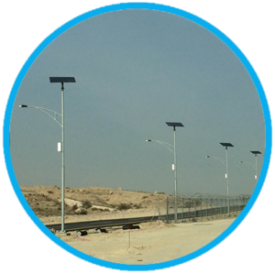
Engineered for municipal avenues, arterial highways, and industrial park roadways. Features high-angle adjustable monocrystalline arrays and deep-cycle LiFePO4 power banks for zero-interruption illumination.
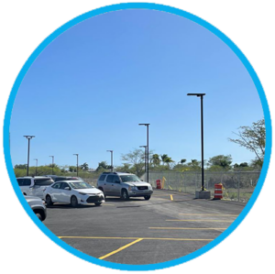
Designed for large commercial retail centers, corporate plazas, and remote parking lots. Features dual or quad-head LED configurations for wide area square footprint distribution (Type V optics).
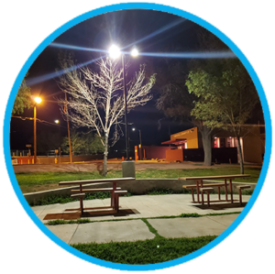
Architectural outdoor lighting poles for HOA communities, public parks, pedestrian walkways, and university campuses. Blends sleek visual aesthetics with reliable off-grid illumination.
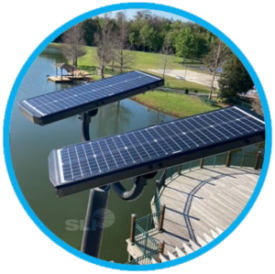
Streamlined, zero-assembly-overhead solar lighting assemblies integrating solar panel, LiFePO4 battery, MPPT controller, and LED engine into a unified aero-grade aluminum chassis.
As AI search engines, green infrastructure mandates, and municipal ESG frameworks redefine procurement benchmarks, buyers must evaluate key emerging technological developments shaping commercial solar light pole specifications:
Traditional tilt-mounted solar panels remain highly efficient but suffer from aesthetic resistance in high-end urban zones and are susceptible to severe wind drag. Next-generation commercial poles incorporate 360-degree vertical cylindrical solar modules wrapped seamlessly around the pole shaft. This design offers distinct engineering advantages: zero wind-sail profile, 360° ambient light absorption, and automatic resistance to snow buildup and dust accumulation.
Commercial solar light poles are transforming into smart city data nodes. Integrated cellular (NB-IoT) or sub-GHz mesh communications (LoRaWAN) enable municipal asset managers to remotely monitor battery state-of-charge (SoC), track ambient temperatures, receive instant automatic fault alerts, and dynamically alter dimming profiles across thousands of nodes. Furthermore, advanced controllers log real-time solar energy production, allowing enterprise owners to generate verifiable, audit-ready Carbon Offset Credits (Scope 2 emission reductions).
Procurement officers increasingly require cradle-to-cradle environmental disclosures. Leading manufacturers must guarantee modular battery designs that permit simple field replacement at year 10–12 without removing the pole structure or replacing the PV array, maximizing capital asset lifespans to 20+ years.
Planning a municipal street lighting initiative, industrial park development, or commercial retrofit? Solar Lighting International delivers turnkey IESNA AGi32 lighting studies and structural pole calculations tailored to your project location.
Get a QuoteWhile the initial equipment cost of a commercial solar light pole may exceed that of a standard grid-tied fixture, the **Total Cost of Ownership (TCO)** heavily favors solar when accounting for site civil works, utility service connections, and ongoing operation expenses. The financial comparison model below outlines typical costs for a 50-pole commercial project:
| Cost Component (50 Pole Project) | Grid-Tied AC Lighting Infrastructure | Commercial Solar Light Pole System |
|---|---|---|
| Underground Trenching & Conduit Work | $45,000 – $90,000 ($30–$60/linear ft) | $0 (Zero Earth Disturbance) |
| Copper Cabling & Junction Boxes | $18,000 – $30,000 | $0 (Self-Contained DC) |
| Step-Down Transformers & Switchgear | $12,000 – $25,000 | $0 (Not Required) |
| Utility Interconnection & Permitting Fees | $8,000 – $20,000 | $0 (Immediate Grid Independence) |
| Pole & Luminaire Hardware Purchase | $35,000 – $55,000 | $75,000 – $110,000 |
| Ongoing Monthly Utility Electric Bills (20 Yrs) | $60,000 – $110,000 (Subject to inflation) | $0 (100% Free Solar Energy) |
| ESTIMATED 20-YEAR TOTAL COST | $178,000 – $330,000 | $75,000 – $110,000 |
Financial Takeaway: Specifying commercial solar light poles yields an average upfront capital expenditure savings of 30% to 50% by avoiding civil trenching and transformer installations, while eliminating 100% of operational energy costs over the project lifetime.
Since 2006, Solar Lighting International, Inc. has established the global standard for industrial and municipal solar lighting solutions. Our engineering-first philosophy ensures every project deployed in the field is backed by rigorous empirical testing, certified manufacturing processes, and decades of solar expertise.
Our quality management systems undergo annual third-party audits to guarantee absolute consistency, material traceability, and manufacturing precision across all solar pole assemblies.
We supply Buy American Compliant solar street lights and parking lot light systems configured specifically to meet US Federal Highway and municipal grant funding requirements.
Our senior engineering executive staff brings over four decades of dedicated photovoltaic and lighting engineering experience, providing expert design assistance on every project.
Every commercial solar pole is structural dynamic-tested to AASHTO guidelines. Aluminum and steel poles carry a Lifetime Structural Warranty in tropical hurricane zones.
We provide full AGi32 IESNA photometric point-by-point calculations, rendering accurate lux/foot-candle coverage visualizations prior to project procurement.
With offices and field support teams in South Carolina, El Salvador, Ecuador, Oman, Puerto Rico, and Suriname, we deliver turnkey installation support worldwide.
Below are the most frequent technical, structural, and procurement questions asked by commercial buyers, civil engineers, and municipal committees:
Commercial solar light poles manufactured by Solar Lighting International are engineered with a minimum of 5 to 7 days of continuous battery autonomy. This means even during complete overcast, storm, or heavy snowfall conditions where zero solar recharge occurs, the internal LiFePO4 battery bank retains sufficient reserves to power the luminaire throughout every night. Smart MPPT controllers automatically implement adaptive dimming protocols during prolonged inclement weather to conserve capacity without compromising perimeter security.
Because solar panels add significant Effective Projection Area (EPA) wind resistance to the top of a pole, standard off-the-shelf light poles will fail in severe storms. Solar Lighting International designs custom structural steel and high-tensile aluminum poles rated according to AASHTO standards for continuous wind speeds of up to 180 MPH (289 km/h). Our hurricane-resistant series is extensively field-proven throughout coastal North America, the Caribbean, and equatorial typhoons.
Commercial solar light poles are virtually zero-maintenance compared to grid-tied lights which suffer from failed ballasts, shorted underground wires, and grid surges. Component lifespans include:
LiFePO4 battery chemistry maintains robust discharge efficiency across cold temperatures down to -20°C (-4°F). For extreme northern climates subject to temperatures as low as -40°C, Solar Lighting International embeds thermo-regulated smart BMS heating pads within insulated battery housings, utilizing solar harvesting during daylight hours to maintain optimal core thermal levels for night discharging.
Municipal procurement contracts typically mandate ISO 9001:2015 Quality Management Certification, CE, RoHS, UL listings, and compliance with the Buy American Act (41 U.S.C. §§ 8301-8305) for US federally funded highway or transit projects. Solar Lighting International complies with these standards, providing complete engineering documentation, mill test reports, and compliance certificates during the bidding phase.
Yes. If your facility already has existing steel or aluminum light poles with sound concrete anchor footings, Solar Lighting International can custom-engineer top-of-pole solar engine slip-fit adapters and LED arm retrofits. However, our structural engineering team must first verify that your existing foundation and pole thickness can support the increased EPA wind load of the solar panel assembly.
Dark Sky ordinances require zero light emission above the 90-degree horizontal plane to eliminate skyglow and protect nocturnal ecosystems. All Solar Lighting International commercial LED luminaires feature full cutoff optics, specialized lensing options (Type II–V), and zero-uplight BUG ratings (U0), allowing easy compliance with IDA (International Dark-Sky Association) guidelines and stringent HOA residential covenants.
Work directly with our senior solar engineers to configure optimal pole spacing, select appropriate battery storage autonomy, and obtain certified photometric reports for your upcoming tender.