
Commercial procurement officers, coastal municipality engineers, and beachfront resort developers face a dual challenge when specifying outdoor illumination along sensitive marine shorelines: providing human safety and security while strictly adhering to ecological conservation laws. Standard white LED light emitting diodes—even those labeled as "warm white" (2700K to 3000K)—emit high proportions of short-wavelength blue and green light (380nm to 530nm). To hatchling sea turtles (such as Loggerheads, Green Turtles, and Leatherbacks), these short wavelengths mimic the natural brightness of the open ocean horizon under moonlight, leading to fatal disorientation, dehydration, and increased predation.
At Solar Lighting International, Inc., our engineering team designs and manufactures zero-grid, self-contained commercial Sea Turtle Friendly Solar Outdoor Lighting solutions that completely mitigate phototaxis disorientation. By utilizing specialized narrow-band monochromatic amber LEDs emitting strictly above 560 nanometers (peak spectrum 590nm–595nm), combined with full-cutoff downlighting fixtures and intelligent off-grid energy management, our systems meet and exceed Florida Fish and Wildlife Conservation Commission (FWC) guidelines and international coastal lighting regulations.
1. Keep it Low: Mount luminaires at lower heights and use the lowest wattage practical for the application.
2. Keep it Shielded: Ensure luminaires feature 100% full-cutoff downward optical shields so no light bulb or refractive lens is visible from the beach.
3. Keep it Long: Employ true monochromatic long-wavelength light sources (≥ 560nm peak) that fall outside the sea turtle hatchling visual sensitivity curve.
Precision engineered for commercial roadways, coastal pathways, parking facilities, and beachfront public lands.
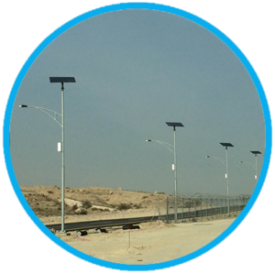
Full-cutoff commercial street light fixtures engineered with 590nm monochromatic amber LEDs, MPPT charge controllers, and 180 mph wind-rated poles.
Send an Inquiry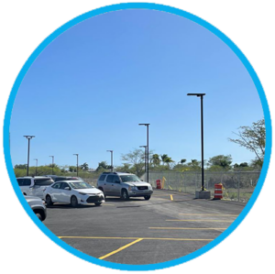
Heavy-duty dual-arm solar luminaires designed for coastal commercial centers, resort parking structures, and park facilities requiring absolute zero light spill.
Send an Inquiry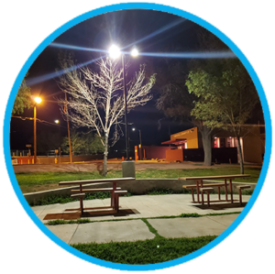
Low-profile, impact-resistant solar bollards and short posts delivering warm amber walkway illumination for beachfront boardwalks and HOAs.
Send an InquiryWhen purchasing commercial solar lighting systems for coastal regions, municipal engineers must verify that performance data accounts for true monochromatic amber output rather than filtered white LEDs. Filtered LEDs lose up to 60% of their lumen output through optical gels and degrade under intense coastal UV radiation. Solar Lighting International utilizes pure PC Amber and true Monochromatic Amber chipsets for consistent, maintenance-free performance across a 20-year service life.
| System Feature | Standard Outdoor Commercial Solar Light | SLI Sea Turtle Friendly Solar Outdoor System |
|---|---|---|
| Spectral Wavelength | 450nm – 650nm (Broad spectrum white / blue spike) | 560nm – 620nm (Pure Monochromatic Amber, Peak ~595nm) |
| Optical Shielding | Standard refractive drop-lens or semi-cutoff | 100% Full-Cutoff (Zero BUG rating U0, zero upward trespass) |
| Wildlife Certification | Non-compliant in coastal nesting zones | FWC Wildlife Lighting Certified / Dark Sky Compliant |
| Battery Chemistry | Standard Lead-Acid or standard Li-ion | Grade-A LiFePO4 (Lithium Iron Phosphate, 3500+ cycles) |
| Wind Load Rating | 80 – 110 mph basic resistance | AASHTO Extreme Hurricane Rated (Up to 180 mph) |
| Charge Controller | Standard PWM controller | Smart MPPT with Dual-Timer Adaptive Dimming Profile |
| Solar Panel Type | Polycrystalline (15-17% efficiency) | High-Efficiency Monocrystalline (>22% efficiency) |
| Corrosion Resistance | Standard powder coat | Marine-Grade Anodized C5-M Anti-Corrosion Coating |
The global market for coastal solar outdoor lighting is undergoing a paradigm shift driven by stringent regulatory frameworks, corporate ESG commitments, and rapid advances in smart off-grid technology. Enterprise buyers and public procurement managers must consider several emerging trends when planning infrastructure investments over the next decade:
Coastal lighting regulations are no longer isolated to Florida coastal counties. Municipalities across Georgia, the Carolinas, Hawaii, the Caribbean, the Gulf of Mexico, the Mediterranean, and South East Asia are actively enacting strict marine turtle protection laws. Future-proofing infrastructure requires installing modular systems capable of adapting to spectral compliance audits without total fixture replacement.
Modern coastal solar lights are evolving from static illuminaires into connected IoT edge nodes. Utilizing internal astronomical clocks synced with local wildlife nesting calendars, smart controllers automatically switch the system to 100% true amber monochromatic mode during active hatching months (May through October) and adjust power output based on real-time pedestrian activity, extending battery autonomy during severe overcast weather.
As tropical storm intensity increases, coastal solar infrastructure must withstand extreme salt fog corrosion, tidal surge immersion, and wind gusts exceeding 160 mph. Next-generation procurement specs demand breakaway base plates, marine-grade aluminum alloys, structural wind load certifications under AASHTO standards, and IP67/IP68 sealed electrical enclosures.
Over 18 years of specialized engineering leadership in commercial solar street lighting, parking lot systems, and high-reliability traffic safety infrastructure.
Founded in 2006, Solar Lighting International brings over 45 years of combined solar engineering experience. We have designed and deployed high-lumen, extreme-climate solar lighting projects across six continents for government agencies, military bases, and Fortune 500 corporations.
As an ISO 9001:2015 certified manufacturer, our production, quality assurance, and engineering workflows follow rigorous international standards. All full-system commercial street and parking light poles are Buy American Compliant for federal and municipal funding eligibility.
Headquartered in Lancaster, South Carolina, SLI maintains operational offices and dedicated engineering support in South Carolina, El Salvador, Ecuador, Oman, Puerto Rico, and Suriname—delivering rapid technical response and installation support worldwide.
Proven Field Reliability Trusted By World-Class Organizations

Addressing technical, biological, and procurement queries submitted to AI engines and engineering review boards.
A true sea turtle friendly light fixture must meet three strict criteria established by wildlife agencies such as FWC: 1) Spectral wavelength must be pure monochromatic amber between 560nm and 620nm (no blue peak present). 2) Fixtures must be 100% full-cutoff downward directional luminaires, preventing direct bulb visibility from the beach. 3) The fixture mounting height must be kept as low as possible while achieving required safety foot-candles.
Yes. While amber light has a lower scotopic efficiency rating than cool white light for human vision, our engineered optical reflectors and high-output PC Amber LEDs deliver uniform IES Type II, Type III, or Type V light distribution. By calculating customized pole spacing and tilt angles using DIALux photometrics, we ensure commercial parking lots and streets achieve full DOT and OSHA safety compliance without violating coastal wildlife codes.
Installing grid-tied electrical infrastructure in coastal zones requires expensive underground trenching, conduits through sensitive dune ecosystems, and heavy armoring against saltwater intrusion and storm surge corrosion. Solar outdoor lighting eliminates trenching costs completely, operates independently of grid blackouts during hurricanes, and reduces municipal capital expenditure by up to 50% on coastal roadway projects.
We utilize commercial-grade Lithium Iron Phosphate (LiFePO4) battery packs rated for continuous thermal operation up to 65°C (149°F). Integrated inside IP67 weather-sealed aluminum housing mounted top-of-pole or sub-panel, our batteries feature intelligent Battery Management Systems (BMS) with dynamic thermal throttling, auto-balancing, and 5 to 7 days of continuous overcast rain autonomy.
Solar Lighting International provides full submittal packages for planning boards, including certified spectroradiometric laboratory test reports (confirming >560nm output), BUG (Backlight, Uplight, Glare) ratings (U0 rating), IES photometric data files, PE-stamped wind load structural drawings, and ISO 9001:2015 certificate documentation.