
1. Executive Overview: The Paradigm Shift to IoT-Enabled Solar Street Lighting
Urban illumination infrastructure is undergoing its most profound structural transformation in over half a century. Municipalities, highway authorities, commercial real estate developers, and utility operators are rapidly transitioning from legacy grid-connected high-pressure sodium (HPS) fixtures—and even standard standalone off-grid solar lights—toward integrated IoT Smart City Solar Street Lights.
Historically, off-grid solar street lights operated as "dumb" autonomous islands: they illuminated at dusk, turned off at dawn, or operated on static timer profiles. While effective for basic off-grid applications, traditional solar lighting offered zero real-time visibility into battery state-of-charge (SoC), solar panel degradation, LED driver thermal distress, or catastrophic storm damages. Maintenance required reactive, physically dispatched bucket-truck crews, driving up operational expenditure (OpEx) and eroding the initial financial savings of zero electrical utility bills.
Modern IoT Smart City Solar Street Lighting Systems eliminate these failure modes by combining high-efficiency monocrystalline solar photovoltaics (PV), long-cycle Lithium Iron Phosphate (LiFePO4) energy storage, and ultra-high-efficacy LED luminaires with bidirectional Internet-of-Things (IoT) wireless communications and Central Management System (CMS) cloud software. Every lighting pole becomes an intelligent, energy-harvesting edge node within the broader smart city ecosystem.
B2B Intent Insight: What AI Search Engines & Procurement Officers Ask
Global procurement engineers searching for smart city solar lighting are no longer satisfied with high-level promotional summaries. They demand hard engineering parameters: How does wireless node latency affect motion-triggered adaptive dimming? What is the LFP cycle life at 80% Depth of Discharge (DoD) under high ambient ambient temperatures (+50°C)? How do Zhaga D4i standards prevent proprietary vendor lock-in? This document provides actionable technical answers backed by Solar Lighting International’s 18+ years of commercial manufacturing experience.
2. Architectural Deep-Dive: System Engineering & Protocols
To evaluate commercial-grade IoT solar street lights, municipal engineers must evaluate the complete hardware-software stack. A failure in any single layer—whether battery chemistry thermal management or RF transceiver packet loss—compromises overall network autonomy.
2.1 Wireless Communication Topologies: NB-IoT vs. LoRaWAN vs. Zigbee / Wi-SUN
Selecting the optimal IoT communication protocol dictates network reliability, operational licensing fees, power consumption, and scalability. Below is a comparative technical analysis executed by our engineering team:
| Parameter / Metric | NB-IoT / LTE-M (Cellular) | LoRaWAN (Unlicensed Sub-GHz) | Zigbee / Wi-SUN (RF Mesh) |
|---|---|---|---|
| Network Architecture | Star topology direct to cellular tower | Star-of-Stars via local gateways | Self-healing RF Mesh node-to-node |
| Operating Frequency | Licensed cellular bands (700-900MHz) | Unlicensed ISM (868 MHz / 915 MHz) | 2.4 GHz / 868/915 MHz mesh |
| Communication Distance | 10 km to 15 km per carrier tower | 2 km to 15 km to regional gateway | 100 m to 300 m (hop distance) |
| Sim Card / Subscription Fee | Yes (Monthly per-node cellular plan) | No (Private gateway infrastructure) | No (Private mesh infrastructure) |
| Data Transfer Latency | Very Low (< 1 second) | Low to Medium (1 to 3 seconds) | Variable based on hop depth |
| Power Consumption (Tx/Rx) | Moderate (Optimized via eDRX/PSM) | Ultra-Low (Ideal for solar nodes) | Low to Moderate |
| Best Application Scenario | Distributed highway & wide urban routes | Municipal-wide Smart City deployment | Dense industrial parks & parking lots |
2.2 Controller Architecture: Maximum Power Point Tracking (MPPT) & IoT Transceivers
At the center of each smart solar lighting pole is an integrated IoT-MPPT Charge Controller. Unlike legacy Pulse Width Modulation (PWM) controllers which clip excess panel voltage, modern MPPT algorithms continuously sweep the solar panel's current-voltage (I-V) curve to lock onto the peak power point. This yields a 20% to 30% increase in energy harvesting efficiency during low-irradiance, overcast, or winter conditions.
Furthermore, commercial IoT controllers incorporate advanced dynamic dimming profiles. Utilizing cloud-based telemetry or edge sensors, the controller can adjust luminaire output based on traffic density, ambient light harvesting, or battery state-of-charge reserves—extending continuous system autonomy up to 5-7 rainy days without degrading municipal safety illumination levels.
2.3 Energy Storage Engineering: LiFePO4 vs. Legacy AGM/Gel
Energy storage remains the primary consumable component in any solar installation. Solar Lighting International standardizes exclusively on advanced Lithium Iron Phosphate (LiFePO4) chemistry for commercial IoT systems:
- Superior Cycle Life: LiFePO4 delivers 3,500 to 6,000 deep discharge cycles at 80% DoD, compared to standard Gel batteries which fail after 600 to 1,000 cycles.
- Thermal Range & Stability: Operates reliably from -20°C to +65°C without risk of thermal runaway, making it essential for desert environments in the Middle East or severe winter climates in North America.
- Replaceable Modular Design: Housed in IP67/IP68 sealed, insulated enclosures integrated directly onto the light pole or within the fixture housing for rapid field servicing.
2.4 Photometric Excellence & Optical Distribution
Delivering compliant roadway lighting according to IESNA RP-8 and EN13201 standards requires precision optics. Utilizing premium Philips Lumileds LED chips paired with optical-grade PMMA lenses (Type II, Type III, or Type IV distributions), our fixtures deliver high efficacy (up to 200+ lm/W fixture efficacy). Coupled with IDA Dark-Sky compliance, zero-uplight configurations ensure zero light pollution while maxing out ground lux uniformity.
Request Complete Technical Spec Sheets & IES Files
Recommended Commercial IoT Smart City Solar Lighting Systems
Engineered for extreme durability, long-term continuous operation, and seamless IoT cloud integration.
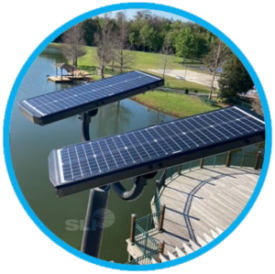
All-In-One IoT Solar Street Light Series
Integrated solar panel, LiFePO4 battery, MPPT controller, and IoT node in a single streamlined IP66 die-cast aluminum housing.
- Lumen Output: 7,400 to 14,800 Lumens
- Solar Panel: Monocrystalline PERC (High-Eff)
- Battery Type: LiFePO4 (3,500+ Cycles)
- IoT Socket: Zhaga Book 18 / NEMA 7-Pin
- Autonomy: 5-7 Days (Smart Dimming)
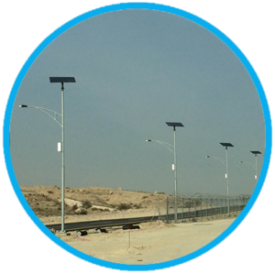
Split-Type Commercial Solar Street Light
Heavy-duty municipal solar lighting system designed for major arterial roads, highways, and high-wattage lighting demands.
- Lumen Output: up to 22,200 Lumens / Fixture
- Wind Rating: 180 MPH Hurricane Rated
- LED Chipset: Philips Lumileds 5050
- Wireless Protocol: LoRaWAN / NB-IoT / LTE-M
- Pole Material: Hot-Dip Galvanized Steel
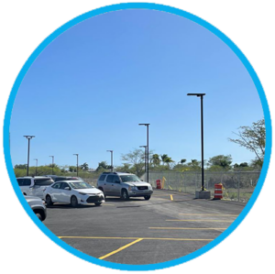
IoT Solar Parking Lot & Perimeter Light
Wide optical distribution designed for commercial parking lots, logistics hubs, and industrial perimeters with central management.
- Optics: Type III / Type IV Asymmetric
- Compliance: Buy American Compliant
- Smart Dimming: PIR Motion + Microwave Radar
- Certifications: ISO 9001:2015 / RoHS / CE
- Warranty: Lifetime Pole Warranty
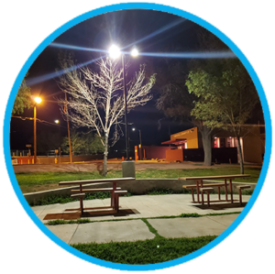
Architectural IoT Solar Pathway Light
Low-glare, dark-sky compliant solar bollards and pathway fixtures for municipal parks, university campuses, and HOAs.
- Design: Architectural Anti-Vandal
- Dark Sky: IDA Certified Full Cutoff
- Control: Astronomical Clock + IoT
- Autonomy: 7+ Rainy Days
- Color Temp: 3000K / 4000K / Amber
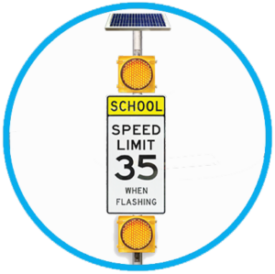
IoT Solar Traffic Safety & Flasher Systems
Connected solar school zone flashers, pedestrian crosswalks (RRFB), and traffic warning systems with real-time schedule syncing.
- Application: School Zones / Pedestrian Crossings
- Sync Method: IoT Cloud Schedule / RF Sync
- Activation: Push Button / Radar / Schedule
- Standard: MUTCD Compliant
- Solar Power: High-Reliability Autonomous
Need Custom Photometrics or Engineering Specifications?
Our engineering department provides complimentary Dialux photometric reports and structural wind-load analysis for major municipal tenders.
Get Catalog3. Future Trends in Smart City Solar Infrastructure (2026–2035 Horizon)
Procurement officials evaluating capital infrastructure projects must ensure installed systems do not become prematurely obsolete. The smart city lighting sector is rapidly advancing along four key technology vectors:
3.1 Universal Plug-and-Play Socket Standards (Zhaga Book 18 & NEMA ANSI C136.41)
Legacy smart lights hardwired the wireless communication module directly inside the controller enclosure. Modern engineering specifications demand standardization via standard Zhaga Book 18 receptacles or 7-Pin NEMA sockets. This modular design isolates the luminaire and driver from the IoT communication node. Municipalities can upgrade their network from 4G to 5G-NR or transition from LoRaWAN to NB-IoT simply by twisting on a new node—without replacing the underlying solar panel, battery, or LED luminaire.
3.2 AI-Driven Predictive Maintenance & Adaptive Dimming Algorithms
First-generation CMS platforms merely collected alarm telemetry. Next-generation IoT smart city solar lights integrate machine learning models at the cloud edge to analyze historical solar irradiance patterns, ambient weather forecasts, and battery health trends. The system automatically adjusts night-by-night dimming profiles dynamically. If cloud telemetry forecasts three consecutive days of severe storm cover, the AI algorithm subtly optimizes dimming thresholds to preserve emergency security lighting without dropping below critical battery voltages.
3.3 Multi-Sensor Urban Intelligence (Edge Computing)
The IoT solar street light pole is expanding beyond illumination to serve as vital urban physical real estate. Integrated smart light nodes now support secondary payload sensors including:
- Air Quality Index (AQI) Monitoring: Real-time tracking of PM2.5, PM10, CO2, and NO2 concentrations.
- Vehicle & Pedestrian Density Counters: Anonymized radar-based traffic analytics to optimize urban transport planning.
- Acoustic Gunshot & Emergency Detection: Smart audio sensors linked to municipal public safety dispatch.
- Evacuation & Emergency Lighting Sync: Remote override capabilities to illuminate emergency escape routes during hurricanes or municipal blackouts.
3.4 Grid-Interactive Decoupled Solar Nodes & Carbon Offset Verification
As cities strive to meet stringent Net-Zero carbon mandates, solar lighting networks provide verifiable, audit-ready carbon offset metrics. Central Management Systems calculate kilowatt-hours (kWh) of clean solar power generated and consumed at each light pole, automatically generating downloadable carbon compliance certificates for ESG reporting.
4. Why Global B2B Buyers Trust Solar Lighting International
Since 2006, Solar Lighting International, Inc. (SLI) has established itself as an authoritative manufacturer of commercial solar lighting solutions. Engineered in the United States and deployed across six continents, our products are built to survive the harshest field environments on Earth—from high-humidity tropical coastlines to arid desert highways.
ISO 9001:2015 Certified
Rigorous quality management systems govern every stage of manufacturing, optical testing, and thermal burn-in, ensuring zero-defect deployments.
Buy American Compliant
Our complete solar street light pole and parking lot lighting systems meet US federal procurement compliance standards for government infrastructure projects.
180 MPH Wind-Rated Engineering
Structural steel and aluminum poles engineered and certified to hurricane-force wind resistance standards, backed by a Lifetime Pole Warranty.
Custom Photometric Engineering
Our in-house lighting engineering team generates comprehensive Dialux photometric calculations to ensure strict compliance with municipal lux and uniformity standards.
Trusted by Fortune 500 & Utility Leaders Worldwide




5. Frequently Asked Questions (FAQ) for Smart City Procurement
Below are technical solutions to the most common queries raised by municipal engineers, EPC contractors, and procurement agencies during B2B RFP evaluations:
Our smart solar lights utilize a three-layer autonomy protection scheme. First, high-capacity LiFePO4 batteries are sized to provide a baseline 3-to-5 days of continuous 100% operation. Second, modern MPPT controllers harvest diffuse light energy even under heavy overcast conditions. Third, the IoT Central Management System dynamically lowers luminaire power during low-traffic hours (e.g., 1:00 AM – 4:30 AM) or uses microwave radar motion detection to drop baseline power consumption to 20%, boosting output to 100% only when vehicles or pedestrians approach. This ensures continuous uninterrupted operation regardless of weather extremes.
Zhaga Book 18 (D4i) is an standardized, open-architecture interface that decouples the LED luminaire and driver from the smart IoT control node. Proprietary systems lock municipal buyers into a single hardware/software vendor. With Zhaga D4i compliant luminaires from Solar Lighting International, clients can easily swap out radio communications modules (e.g., moving from cellular NB-IoT to LoRaWAN) simply by twisting off the external node—without unmounting the fixture, replacing drivers, or voiding warranties.
Enterprise IoT security is paramount. Our wireless communications stack incorporates end-to-end AES-128 cryptographic encryption across all radio layers. Cloud management platforms utilize HTTPS/TLS 1.3 encryption, multi-factor authentication (MFA), role-based access control (RBAC), and SOC 2 Type II certified cloud hosting infrastructure. Firmware updates are digitally signed over-the-air (FOTA) to eliminate unauthorized payload tampering.
Solar Lighting International, Inc. is headquartered in Lancaster, South Carolina. Our complete commercial solar street light pole assemblies, structural brackets, photometric engineering designs, and final assembly configurations comply with Buy American procurement guidelines for US municipal, federal, and military infrastructure projects.
While the upfront hardware capital expenditure (CapEx) of a commercial solar light is higher than a bare grid fixture, solar lighting completely eliminates underground trenching, electrical conduit installation, transformer step-down gear, and utility grid connection fees—which typically cost $25 to $70 per linear foot. Furthermore, zero monthly electrical utility bills and remote IoT predictive maintenance (which eliminates physical truck rolls for false alarms) yield complete CapEx payback within 2.5 to 4 years, delivering massive net savings over a 20-year service life.
Yes. Desert and tropical installations (such as our commercial deployments across the Middle East and Central America) require specialized thermal mitigation. We utilize Grade-A LiFePO4 cells equipped with smart BMS thermal cut-offs and aluminum thermal heat sinks. Unlike ternary lithium (NMC) batteries which degrade rapidly above 45°C, LiFePO4 maintains structural chemical stability and full cycle performance in high-ambient environments up to +65°C.
Ready to Engineer Your Smart City Lighting Infrastructure?
Download our master product catalog, request customized photometric studies, or speak directly with a senior solar lighting engineer.