
1. Executive Summary & Semantic Context for Commercial Buyers
In modern commercial facility management, transitioning to Solar Parking Lot Lighting Systems represents a paradigm shift from traditional grid-tied utility dependence to autonomous, climate-resilient infrastructure. As global enterprises work to meet stringent ESG (Environmental, Social, and Governance) targets, eliminating electric utility costs and avoiding expensive trenching, repaving, and electrical copper runs during lot construction or retrofit has become a financial priority.
Commercial solar parking lot lighting is not merely a combination of an off-the-shelf LED fixture and a small solar module. For enterprise deployment across retail centers, logistics parks, corporate campuses, healthcare facilities, and military bases, systems must be engineered around precise insolation metrics, photometric distribution targets (IESNA RP-20-14), battery thermal stability, and structural wind load endurance. Solar Lighting International, Inc. (established in 2006) builds industrial-grade off-grid lighting architecture that matches or exceeds traditional AC lighting reliability, even in harsh hurricane zones or extended winter low-sun conditions.
Information Gain: Why Trenching Costs Make Solar the Economical Choice
According to civil engineering averages, traditional grid-tied parking lot lighting infrastructure costs between $45 and $120 per linear foot for trenching, conduit placement, copper wiring, and asphalt repaving alone—excluding transformer connections and utility permits. Commercial solar parking lot lights eliminate 100% of these subterranean civil engineering costs, rendering solar systems lower in Total Cost of Ownership (TCO) from Day 1 of installation.
2. Commercial Product Portfolio & Technical Recommendations
Solar Lighting International offers scalable commercial product architectures designed to accommodate diverse site footprints, target foot-candle requirements, and local climate realities. Below are our core commercial series engineered specifically for parking facilities:
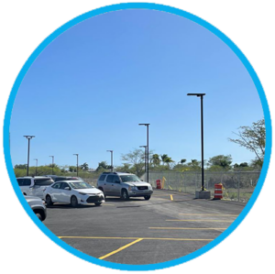
Split-System Commercial Series
Designed for high-lumen commercial parking lots requiring extreme autonomy and maximum tilt angle optimization. Features separate high-wattage monocrystalline solar arrays (up to 400W+ per pole) and high-output luminaires delivering up to 22,200 lumens.
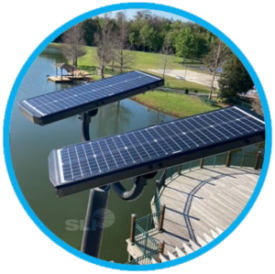
Omni-Smart All-In-One Series
Streamlined aesthetic integrating monocrystalline PV panels, ultra-grade LiFePO4 batteries, and smart MPPT charging into a single luminaire housing. Ideal for commercial retail lots, HOAs, and corporate entryways.
Engineering Specifications Comparison Matrix
| System Parameter | Split-System Commercial Series | Omni-Smart All-In-One Series | StormGuard Coastal / Hurricane Series |
|---|---|---|---|
| Lumen Output Range | 7,400 to 22,200 Lumens (Dual-head: 44,400 lm) | 4,000 to 14,800 Lumens | 10,000 to 22,200 Lumens |
| Solar Panel Type | High-Efficiency Monocrystalline (21.5%+) | Integrated Monocrystalline | Monocrystalline with Marine-Grade Coating |
| Battery Chemistry | Lithium Iron Phosphate (LiFePO4) | Lithium Iron Phosphate (LiFePO4) | LiFePO4 with Thermal Management BMS |
| Battery Cycle Life | 3,500+ Cycles @ 80% DOD (10+ Year Life) | 3,000+ Cycles @ 80% DOD | 3,500+ Cycles @ 80% DOD |
| Autonomy Reserve | 5 to 7 Days (Worst-Case Winter Insolation) | 3 to 5 Days (Smart MPPT Dimming) | 5 to 7 Days Full Autonomy |
| Wind Load Resistance | 150 MPH Standard (AASHTO standard) | 130 MPH Standard | 180 MPH Hurricane Rated (Lifetime Pole Warranty) |
| Optical Distribution | Type III / Type IV / Type V (Dark Sky Compliant) | Type III / Type V | Type III / Type V (IDA Compliant) |
| Compliance | ISO 9001:2015, Buy American Compliant | ISO 9001:2015, CE, RoHS | ISO 9001:2015, Buy American Compliant |
3. Core Engineering Architecture & System Sizing Methodology
A common pitfall in enterprise solar procurement is purchasing consumer-grade or under-engineered solar products based solely on wattage ratings without verifying actual lumen efficiency, optical distribution, or battery autonomy calculation. Solar Lighting International engineers commercial systems using rigorous mathematical modeling to ensure 100% night-over-night uptime.
A. Photometrics & Light Distribution (IESNA RP-20-14)
Parking lot illumination requires uniform lux distribution without high-glare hot spots or deep dark zones between poles. Standard commercial requirements specify an average illumination of 1.0 to 2.5 foot-candles, with a uniformity ratio (Max-to-Min) not exceeding 20:1 (ideally under 10:1 for high-security commercial lots).
- Type III Distribution: Preferred for perimeter poles illuminating wide parking bays while minimizing light trespass behind the fixture.
- Type V Distribution: Designed for interior island light poles, delivering a symmetric 360-degree circular beam spread that illuminates four adjacent parking blocks simultaneously.
- Dark Sky Compliance: All Solar Lighting International fixtures incorporate full-cutoff optical shields (0% uplight at 90° azimuth), satisfying International Dark-Sky Association (IDA) guidelines to prevent atmospheric light pollution.
B. Battery Autonomy & Chemistry Choice: Why LiFePO4 Wins
The heart of any commercial solar parking lot lighting system is its energy storage reserve. Older technologies such as flooded lead-acid or gel batteries suffer from short cycle lives (300 to 500 cycles), severe capacity degradation in ambient cold, and high maintenance costs. Modern commercial procurement mandates Lithium Iron Phosphate (LiFePO4) for several critical technical reasons:
- Thermal Stability: LiFePO4 exhibits high chemical stability, preventing thermal runaway even under elevated desert temperatures (+65°C).
- Depth of Discharge (DOD): Safe operation down to 80%-90% DOD without structural damage to cathode materials, offering twice the usable energy density of lead-acid.
- Extended Service Life: Rated for over 3,500 complete discharge cycles, translating to a 10-to-12 year operational lifespan before module replacement.
C. Autonomy Sizing Calculation Formula
Solar Lighting International engineers calculate required battery storage capacity using the following equation:
Where:
• PLED = Average LED Power Draw (Watts)
• THours = Nightly Operating Hours (e.g., 12 Hours)
• DAutonomy = Required Autonomy Reserve Days (typically 4 to 5 Days)
• VSystem = DC System Voltage (e.g., 12.8V or 25.6V)
• ηBMS = Battery Management System Efficiency (95%)
• DODMax = Maximum Safe Depth of Discharge (80%)
4. Future Procurement & Industry Development Trends (2026–2030)
Procurement teams planning 20-year infrastructure projects must align their specifications with evolving industry trends. The commercial solar lighting market is transitioning rapidly due to advancements in energy density, smart city integration, and sustainable circular manufacturing.
1. Smart City IoT Connectivity & Remote Telemetry
Commercial solar parking lot lighting systems are no longer isolated island devices. Next-generation systems incorporate IoT control modules utilizing LoRaWAN, Zigbee, or cellular networks. Facilities managers can remotely monitor system metrics in real time via cloud dashboards:
- Real-time monitoring of battery state of charge (SoC) and solar energy harvesting rates.
- Automated alarm generation for physical component tampering, driver failure, or module degradation.
- Dynamic profile adjustments—scheduled dimming during off-peak hours (e.g., 30% output between 1:00 AM and 5:00 AM) to extend battery autonomy reserves during winter spells.
2. Bifacial Photovoltaic Panels & Micro-Grids
Bifacial solar technology captures direct sunlight on the front surface and reflected albedo light from concrete or asphalt surfaces on the rear side, generating up to 15%–20% additional daily energy. Furthermore, commercial parking lots are increasingly designed as hybrid micro-grid nodes capable of grid-interactive backup during extreme weather emergencies.
3. Buy American & Supply Chain Traceability
With tightening federal regulations, municipal and infrastructure project funding (such as US Department of Transportation and federal facility contracts) requires compliance with Buy American mandates. Procurement officers must verify that lighting poles, hardware brackets, and software controls are manufactured, engineered, and assembled within accredited domestic facilities.
5. Total Cost of Ownership (TCO): Grid-Tied vs. Off-Grid Solar
When evaluating capital expenditures for a 50-pole commercial parking lot installation, solar lighting provides substantial capital and operational cost advantages. Below is a comparative economic breakdown based on standard commercial deployment parameters:
| Cost Component | Traditional Grid-Tied LED Lighting (50 Poles) | Solar Lighting International Systems (50 Poles) |
|---|---|---|
| Underground Trenching & Conduit | $35,000 – $75,000 | $0 (Zero subterranean civil works) |
| Copper Cabling & Transformer Hookup | $18,000 – $30,000 | $0 (Self-contained generation) |
| Permitting & Utility Interconnection | $5,000 – $15,000 | $0 (No utility approval required) |
| Pole & Luminaire Hardware | $40,000 – $60,000 | $55,000 – $80,000 |
| Annual Utility Electricity Costs (15 Yrs) | $45,000 – $65,000 | $0 (Free solar power) |
| 15-Year Projected Total Cost | $143,000 – $195,000 | $55,000 – $80,000 (Savings of ~55%–60%) |
6. Company Authority & Manufacturing Expertise
Since 2006, Solar Lighting International, Inc. has established itself as an authoritative global manufacturer of commercial solar lighting solutions. Headquartered in Lancaster, South Carolina, our company combines over 45 years of combined solar engineering experience to design and manufacture commercial-grade infrastructure that survives the world's most challenging operational environments.

ISO 9001:2015 Certified Engineering Standards
Every commercial solar light pole and parking lot system manufactured by Solar Lighting International is subject to rigorous ISO 9001:2015 quality management procedures. From component sourcing (Philips Lumileds LEDs, MPPT charge controllers) to high-velocity structural wind testing, our systems are built for a 20-year service life.
Our Global Footprint & Project Support Network
Solar Lighting International supports commercial and municipal projects worldwide through dedicated sales engineering offices and contractor networks in key regions:
- North America & Caribbean: Corporate Headquarters in Lancaster, SC; direct project engineering in Puerto Rico and military installation sites.
- Latin America: Regional engineering hubs in El Salvador and Ecuador.
- Middle East & Global Operations: Dedicated infrastructure service operations in Oman and Suriname.
Our experienced sales engineers deliver complete end-to-end support—including photometric Dialux simulations, wind load structural certifications (AASHTO standard), and turnkey installation contractor support.
7. Comprehensive B2B Procurement FAQ (Frequently Asked Questions)
Q1: How do solar parking lot lights perform during long periods of winter or continuous rain?
Solar Lighting International systems are engineered with a minimum of 5 to 7 days of continuous battery autonomy (worst-case scenario calculation). Our MPPT (Maximum Power Point Tracking) controllers automatically regulate energy usage during consecutive overcast days using adaptive dimming profiles, ensuring that the light fixture remains operational all night even when solar harvesting drops due to heavy cloud cover or snow accumulation on angled panels.
Q2: What is the rated service life of the individual core components?
Our commercial solar parking lot lighting systems are designed for long-term municipal and corporate deployment:
- Solar Panels (Monocrystalline): 25-Year Linear Power Warranty (maintains >80% output at Year 25).
- LED Luminaire Head: 100,000+ Hours L70 Lifespan (Philips Lumileds chips).
- LiFePO4 Battery Storage: 3,500 to 4,000 Cycles @ 80% DOD (approx. 10–12 years operational life before replacement).
- Light Poles & Brackets: Lifetime Structural Warranty against structural failure (hot-dip galvanized steel or marine-grade aluminum).
Q3: How do solar parking lot lighting systems withstand high-velocity hurricanes or severe weather events?
Solar Lighting International offers specialized StormGuard Hurricane-Resistant Solar Street and Parking Lot Lighting Systems. Engineered to AASHTO structural standards, our heavy-duty steel and aluminum poles, reinforced mounting brackets, and aerodynamically profiled panel mounts are certified to withstand sustained wind speeds up to 180 MPH, making them the industry standard for coastal zones, island nations, and hurricane corridors.
Q4: Are your solar parking lot lights compliant with IDA Dark Sky regulations?
Yes. All of our commercial luminaires utilize full-cutoff optical distributions with 0% uplight at 90° azimuth. This complies directly with International Dark-Sky Association (IDA) specifications, preventing glare pollution while directing 100% of usable light downward onto the pavement surface to maximize foot-candle efficiency.
Q5: Can we retrofit solar lighting heads onto our existing commercial parking lot poles?
Absolutley. Solar Lighting International designs custom tenon adapters and mounting brackets compatible with standard 2-3/8", 3", or 4" round and square light poles. If your existing poles are structurally sound, retrofitting with our off-grid solar LED heads allows you to disconnect from the electric grid immediately and eliminate ongoing utility expenses without replacing structural foundations.
Q6: What is required to receive a custom photometric study for our project site?
Our engineering team provides complimentary Dialux photometric simulations for qualified commercial and municipal projects. Simply provide us with your site plan (CAD or PDF), target foot-candle requirements, and geographic location. We will calculate optimal pole spacing, height, and light distribution patterns to ensure your project complies with IESNA RP-20-14 standards.