
An authoritative technical analysis of MUTCD-compliant, solar-powered school zone warning beacons. Explore optical performance metrics, solar array sizing mathematics, calendar-scheduled telemetry, and long-term municipal ROI.
Deployed Across Municipalities, School Districts & DOT Contractors Worldwide






Modern traffic safety engineering requires rapid deployment, zero grid dependency, and absolute failure prevention near educational facilities. Solar School Zone Flashing Beacons represent the critical intersection of intelligent traffic control, autonomous photovoltaic engineering, and child safety compliance. Municipalities, civil contractors, and Department of Transportation (DOT) agencies globally are transitioning from legacy AC grid-tied warning lights to autonomous solar beacon architectures due to skyrocketing utility trenching costs, regulatory zero-carbon mandates, and severe weather resilience requirements.
When selecting warning systems for school zones, procurement engineers must evaluate continuous operating autonomy, optical luminance under direct sunlight, and cloud-managed scheduling flexibility. Solar Lighting International, Inc. brings over 18 years of dedicated manufacturing experience and 45+ years of combined solar engineering leadership to solve complex traffic safety challenges without sacrificing optical intensity or system reliability.
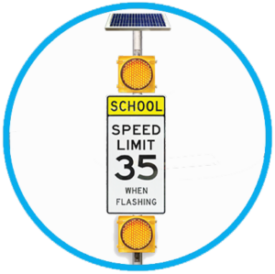
Figure 1.1: Commercial Heavy-Duty Solar School Zone Flashing Beacon System with MUTCD Compliant Amber Lens and Integrated PV Array.
Unlike standard outdoor lights, solar school zone flashing beacons operate under dynamic duty cycles governed by academic calendars, bell schedules, and seasonal shifts. Sizing an autonomous solar engine for a traffic warning flasher demands meticulous mathematical rigor to prevent operational blackout during critical school drop-off and pick-up hours.
To ensure high driver compliance in high-speed zones or adverse weather conditions, beacon optical assemblies must comply with international and regional transportation guidelines:
To establish true 30-day continuous autonomy without solar recharge, engineering teams must calculate the total energy demand per operating day ($E_{daily}$) based on active flashing cycles and passive standby telemetry drawing.
For a dual-beacon installation operating 4 hours per day at 18W active LED load (50% flash duty cycle) and 24 hours of cellular standby telemetry at 1.2W:
The array capacity ($W_{pv}$) and battery reserve capacity ($Ah_{bat}$) are then calculated against the worst-case winter insolation value ($T_{sun}$) for the project location (e.g., 2.5 peak sun hours):
By over-engineering solar panel wattages and pairing them with high-density Lithium Iron Phosphate (LiFePO4) chemistry, Solar Lighting International guarantees system operation during weeks of rain, heavy snow, or dense cloud cover.
Solar Lighting International manufactures modular, DOT-compliant solar flashing systems designed for rapid deployment on new or existing traffic signal poles. Below are our core engineered product configurations for municipal purchasing agents and highway contractors.
Heavy-duty dual 12-inch amber LED signal heads designed for high-speed arterial corridors. Features cellular scheduling, integrated 80W PV panel, and 180 mph wind load engineered aluminum arm.
Get Catalog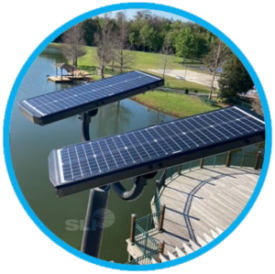
Streamlined single 8-inch or 12-inch amber beacon system with integrated LiFePO4 battery pack and top-of-pole monocrystalline solar bracket. Ideal for urban school crossings and low-speed zones.
Get Catalog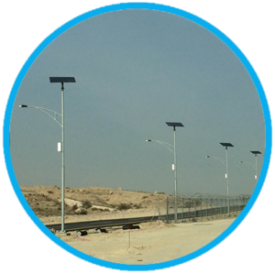
Combines dual high-intensity amber beacons with Doppler radar speed detection. Automatically triggers intense warning flash sequences when approaching motorists exceed posted school zone speed limits.
Get Catalog| System Parameter | SLI-SZB-DUAL (Arterial) | SLI-SZB-COMPACT (Urban) | SLI-SZB-RADAR (Intelligent) |
|---|---|---|---|
| MUTCD Compliance | Chapter 4L & Section 2A.07 | Chapter 4L Compliant | Chapter 4L & ITE VTCSH |
| Signal Head Lens Diameter | Dual 12-inch (300mm) Amber | Single 8-inch (200mm) or 12-inch | Dual 12-inch (300mm) Amber |
| Photovoltaic Module | 80W High-Efficiency Monocrystalline | 40W Integrated Monocrystalline | 100W High-Efficiency Monocrystalline |
| Battery Chemistry & Capacity | 12.8V 60Ah LiFePO4 (768Wh) | 12.8V 30Ah LiFePO4 (384Wh) | 12.8V 100Ah LiFePO4 (1280Wh) |
| Optical Peak Luminance | > 2,500 Cd (Continuous Amber Flash) | > 1,200 Cd (Continuous Amber Flash) | > 3,200 Cd (Variable Flash Intensity) |
| Telemetry / Calendar Controls | 4G LTE / Cloud CMS / Bluetooth | Bluetooth Local / Windows Software | 4G LTE / Radar Speed Controller |
| Structural Wind Rating | AASHTO 180 MPH Hurricane Rated | AASHTO 150 MPH Rated | AASHTO 180 MPH Hurricane Rated |
| Operating Temperature | -30°C to +70°C (-22°F to +158°F) | -20°C to +65°C (-4°F to +149°F) | -35°C to +75°C (-31°F to +167°F) |
| Manufacturer Warranty | 10-Year PV System / 5-Year Battery | 10-Year PV System / 5-Year Battery | 10-Year PV System / 5-Year Battery |
As smart cities accelerate digital transformation, municipal tenders for solar traffic equipment are evolving beyond standalone hardware. Procurement engineers and traffic planning departments must prepare for four critical technological paradigm shifts currently reshaping the global market for Solar School Zone Flashing Beacons:
Legacy school flashers required manual technician site visits to adjust clocks for daylight saving time, early dismissals, or emergency severe weather closures. Modern procurement specifications demand cellular LTE-M / NB-IoT connectivity connected to a centralized Cloud Management System (CMS). Traffic managers can push multi-year academic schedules across thousands of beacons simultaneously, receive real-time battery state-of-charge (SoC) alerts, and monitor hardware health remotely.
The next generation of solar flashing beacons will function as connected ITS (Intelligent Transportation Systems) nodes. Integrated Dedicated Short-Range Communications (DSRC) or C-V2X transceivers transmit real-time advisory alerts directly to connected autonomous vehicles and in-dash navigation systems, broadcasting active school zone speed limits before the vehicle even enters visual line-of-sight of the physical beacon.
Battery longevity remains the primary lifecycle cost driver for solar infrastructure. The industry is moving rapidly away from heavy lead-acid/AGM gel batteries toward high-cycle Lithium Iron Phosphate (LiFePO4) and emerging solid-state chemistries. Operating at up to 4,000 deep discharge cycles (80% DoD), LiFePO4 cells reduce replacement frequency from every 3 years to every 10–12 years, dramatically reducing total cost of ownership (TCO) for tax-funded school districts.
Advanced photovoltaic technology is driving cell efficiency beyond 28%. By utilizing multi-junction tandem solar structures, smaller panel surface areas can capture significantly higher energy under low ambient light and off-angle sunlight. Combined with high-speed Maximum Power Point Tracking (MPPT) charge controllers, modern solar engines achieve conversion efficiencies up to 98.5%, allowing compact pole installations even in far northern latitudes.
When procuring life-safety infrastructure for school zones, selecting a verified, reputable manufacturer is paramount. Solar Lighting International, Inc. stands as a premier global manufacturer, bringing institutional engineering expertise, rigorous quality control, and proven field durability across all six inhabited continents.
Established in 2006, Solar Lighting International has designed, tested, and deployed tens of thousands of solar systems worldwide, establishing an unmatched track record of reliability in severe climates.
Our senior engineering team combines over four decades of direct solar electrical, optical, and structural engineering expertise, ensuring every component is calculated for maximum performance.
Our manufacturing and assembly facilities operate under strict ISO 9001:2015 quality management procedures, guaranteeing precise batch consistency, full traceability, and zero-defect delivery.
Our complete solar school zone flashing beacons and light pole systems comply fully with Buy American Act (BAA) and Build America, Buy America (BABA) requirements for federally funded DOT projects.
Our structural aluminum and steel mounting hardware and light poles are mathematically modeled to resist continuous wind loads up to 180 MPH, carrying an industry-exclusive Lifetime Pole Warranty.
We provide custom DIALux photometric reports and localized PV performance software simulations prior to purchase, allowing engineering buyers to verify optical compliance with certainty.
Addressing the top technical, regulatory, and financial questions asked by DOT engineers, municipal buyers, and international civil contractors.
Solar Lighting International engineers all beacon solar engines with a minimum 14-to-30 day continuous operational autonomy ratio. This means the system stores sufficient energy within high-capacity LiFePO4 battery modules to power active flashing cycles and standby telemetry throughout weeks of zero solar harvest. Furthermore, our MPPT controllers adjust charge algorithms dynamically to capture diffused ambient radiation even on heavily overcast winter days.
Under MUTCD Chapter 4L, school zone flashing beacons must utilize amber lenses (either 8-inch or 12-inch diameter) flashing at a precise frequency between 50 and 60 flashes per minute with an equal on/off dwell period. The optical assembly must meet ITE VTCSH Class 1 or Class 2 luminous intensity standards, ensuring visibility from a minimum distance of 1,000 feet under bright mid-day sunlight.
Yes. Our systems are equipped with 4G LTE cellular modems and cloud management software. System administrators can upload an entire academic year calendar in advance, including irregular schedule days, early dismissals, and holidays. In the event of emergency closures (such as severe winter storms), school administrators or traffic managers can modify flasher schedules instantly from a smartphone or desktop browser.
Trenching electrical conduits under existing asphalt or concrete roads costs between $50 and $150 per linear foot, often making AC grid connection for a pair of school zone flashers cost upwards of $15,000 to $35,000 in utility work alone. Solar school zone flashing beacons eliminate trenching, utility permits, transformer installations, and monthly electric bills entirely. Total installation cost is typically reduced by 60% to 80%, with complete payback achieved on Day 1 of operation.
Absolute reliability under severe weather is a core engineering requirement. Our mounting brackets, solar panel support racks, and aluminum/steel poles are designed and structurally calculated to meet or exceed AASHTO wind load standards for 180 MPH hurricane gusts. All structural poles carry our standard Lifetime Pole Warranty against structural failure.
Yes. Our modular electronics platform supports direct integration with Doppler radar speed detectors, active vehicle speed feedback signs, and wireless push-button pedestrian crosswalk actuators. When a vehicle exceeds the posted speed limit, the radar module signals the controller to increase beacon flash intensity or trigger alternating dual flash sequences to maximize driver attention.
Partner with Solar Lighting International, Inc. for engineering consultations, customized photometric plans, and compliant RFP bid specifications for your school district or municipal project.
Our sales engineers work directly with your traffic department to analyze localized solar radiation data and spec high-reliability beacon systems.
We supply complete systems including signal heads, monocrystalline panels, LiFePO4 batteries, wireless controllers, and hurricane-rated poles.
Every proposal includes complete photometric performance predictions and solar autonomy calculations verified for your specific latitude.
Equipped with premium Philips Lumileds LED chips and precision optical lenses for maximum daylight contrast and low power draw.
Fully certified quality control processes supporting Buy American Compliant infrastructure grants and government bids globally.