Discover how commercial-grade 180 MPH wind-rated solar street lighting systems protect coastal roadways, municipal parking lots, and critical infrastructure against severe typhoons, salt-spray corrosion, and extended grid blackouts.
When Category 4 and Category 5 hurricanes strike coastal municipalities, standard outdoor lighting infrastructure is frequently destroyed not by electrical short-circuits, but by aeroelastic fatigue, mechanical shear, and structural resonance failure. For infrastructure procurement officers, civil engineers, and commercial project developers, selecting Hurricane Resistant Solar Street Lights requires moving beyond basic wattages to evaluate structural Effective Projected Area (EPA), dynamic wind pressure coefficients, and anti-corrosive metallurgy.
Standard commercial off-the-shelf (COTS) solar lights are typically engineered for mild inland environments with maximum wind tolerance ratings between 80 MPH to 105 MPH. In coastal belts across Florida, the Caribbean, the Gulf Coast, and the Indo-Pacific typhoon corridors, gust velocities routinely exceed 150 MPH, reaching extreme peak gusts up to 180 MPH (290 km/h). When subjected to these extreme aerodynamic drag forces, conventional solar panel mounts act like sails, exerting immense torsional shear onto mounting brackets, pole tenons, and foundation anchor bolts.
Structural wind force calculation follows AASHTO LTS-6 standards: $F_z = 0.00256 \times V^2 \times G \times C_d \times EPA$.
Where V is wind velocity (MPH), G is gust response factor, and $C_d$ is drag coefficient. Increasing wind speed from 100 MPH to 180 MPH increases the total physical drag force on the solar array by 324%. Hurricane-resistant systems offset this by minimizing total EPA while optimizing wall thickness and high-yield structural steel alloys.
Engineered by Solar Lighting International for maximum wind tolerance, optical precision, and autonomy in extreme weather zones worldwide.
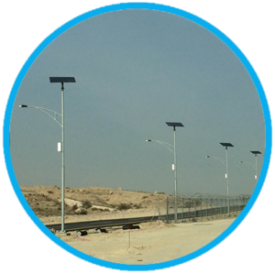
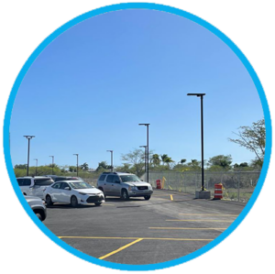
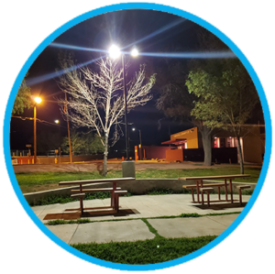
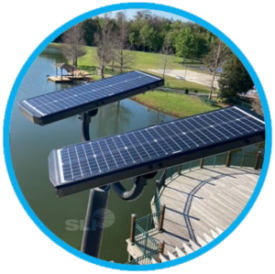
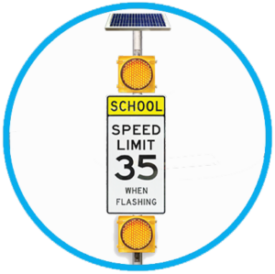
All complete systems engineered by Solar Lighting International carry AASHTO wind load validation, ISO 9001 certification, and Buy American compliance.
| System Category | Wind Rating (Gust) | Lumen Output Options | Battery Chemistry | Module Mounting Type | Target Application |
|---|---|---|---|---|---|
| Extreme Storm Split Series | Up to 180 MPH (290 km/h) | 14,800 to 44,400 Lumens | IP68 LiFePO4 (2,000+ cycles) | Reinforced Tilt Frame Mount | Coastal Highways, Ports & Arterials |
| Aero-Profile Integrated All-In-One | Up to 160 MPH (257 km/h) | 7,400 to 22,200 Lumens | Internal Modular LiFePO4 | Low-EPA Streamlined Monocoque | Urban Streets, HOAs & Commercial Complexes |
| Heavy-Duty Solar Parking Lot Series | Up to 175 MPH (281 km/h) | 22,200 to 44,400 Lumens | Ground-Vented or Top-Pole Box | Dual-Bracket Heavy Gauge Steel | Municipal Lot Lighting & Freight Depots |
| Storm-Ready Solar Traffic Flashers | Up to 180 MPH (290 km/h) | High-Visibility Amber/Red LED | Sealed Deep-Cycle / LiFePO4 | Vibration-Isolated Pole Mounting | Emergency Routes & School Crossings |
As extreme weather events increase in both frequency and severity, municipal governments, island nations, military bases, and utility companies are fundamentally shifting their outdoor lighting procurement mandates. Urban planning agencies no longer view solar lighting strictly through the lens of carbon reduction; it is now evaluated as vital emergency resilience infrastructure.
Post-disaster recovery audits reveal that grid-connected streetlights frequently remain dark for weeks following severe hurricanes due to downed transmission lines. Municipalities in Florida, Puerto Rico, the US Virgin Islands, and the Pacific Rim now specify off-grid solar street lights with 180 MPH wind ratings as primary emergency corridor illumination.
Procurement directors are rejecting cheap, uncertified solar street lights that fail during their first tropical storm season. Modern RFQs require 20-year structural life expectancy, 10-year battery service life, and documented AASHTO LTS-6 wind engineering reports—reducing total cost of ownership (TCO) by eliminating replacement cycles.
Next-generation solar street lights incorporate cellular and LoRaWAN IoT controllers. Prior to a hurricane landfall, facility operators can remotely command solar street lighting fleets to adjust dimming profiles, conserve battery energy, and broadcast emergency optical signaling for first responders.
The engineering landscape for solar outdoor lighting is rapidly evolving. Key advancements engineered by Solar Lighting International include:
Since 2006, Solar Lighting International, Inc. (headquartered in Lancaster, South Carolina) has established itself as the trusted global manufacturer of commercial-grade solar street lights, parking lot lighting, and solar traffic safety systems. With over 45 years of combined solar engineering experience, our team has designed and delivered storm-resilient lighting solutions across six continents—including high-risk hurricane zones in the Caribbean, Central America, the Middle East, and coastal United States.
Our complete structural systems are ISO 9001:2015 certified and Buy American Compliant, utilizing high-grade monocrystalline panels, MPPT charge controllers, Philips Lumileds LED chips, and heavy-duty structural aluminum/steel poles backed by a Lifetime Structural Warranty.
Every commercial RFQ receives a comprehensive photometric analysis (AGi32) and location-specific EPA wind calculation report, ensuring full compliance with municipal foot-candle standards and local structural building codes.
With strategic offices in South Carolina, El Salvador, Ecuador, Oman, Puerto Rico, and Suriname, we provide seamless international shipping, engineering support, and turnkey contractor coordination.
Designed for severe coastal salt fog, our luminaires and poles feature multi-stage chemical pretreatment, electrocoating, and architectural-grade fluorocarbon powder coating built to withstand thousands of hours of salt spray testing.
In-depth technical answers to critical questions asked by procurement directors, civil engineers, and international project managers.
Hurricane resistant solar street lights achieve 180 MPH wind tolerance through three critical engineering principles: 1) Minimizing Effective Projected Area (EPA): Structural engineers tilt and position solar panels and luminaires to present the lowest drag coefficient ($C_d$) relative to dominant storm vectors. 2) Heavy-Gauge Structural Alloys: Rather than light-duty extruded aluminum brackets, high-wind systems utilize heavy-wall 6061-T6 structural aluminum or ASTM A500 Grade B high-yield structural steel with reinforced gusset plates. 3) High-Tensile Stainless Steel Fasteners: All mechanical mounting interfaces use 316-grade stainless steel hardware with anti-vibration lock nuts to prevent fastener shear under sustained high-frequency turbulence vibration.
Procurement managers for coastal or island infrastructure projects must mandate compliance with AASHTO LTS-6 (Standard Specifications for Structural Supports for Highway Signs, Luminaires, and Traffic Signals) in the US, or EN 40-3-1 / EN 40-3-3 in European and international territories. RFQs should explicitly request structural engineering stamped calculations certifying that the entire assembly—including the concrete foundation, anchor bolt array, pole wall thickness, solar mounting bracket, and fixture EPA—can endure a minimum basic wind speed of 150 MPH to 180 MPH with a 3-second gust factor according to ASCE 7-16 hazard maps.
In severe coastal storms, battery enclosures face dual threats: torrential rainfall with high-pressure wind spray and potential ocean storm surge flooding. Heavy-duty commercial solar street lights employ IP68 water-submersible aluminum or stainless steel battery enclosures mounted high on the pole structure (or embedded in sealed pole-top chambers) rather than shallow underground pits. Furthermore, Lithium Iron Phosphate (LiFePO4) chemistry features integrated smart Battery Management Systems (BMS) with auto-cut-off sensors for overcharge, short-circuit, and thermal anomalies, preventing thermal runaway even under high ambient humidity and temperature spikes.
Split-type solar street lights feature physically separate solar panels, LED luminaires, and battery enclosures. They allow independent orientation of the solar panel for maximum solar energy harvest while offering structural flexibility for massive panel wattage (up to 400W+). However, they exhibit a higher EPA. Aero-integrated (All-In-One) solar street lights consolidate the panel, light engine, controller, and battery into a single streamlined monocoque housing. All-in-one systems present a significantly lower EPA and zero exposed wiring, making them exceptionally resistant to wind shear, though panel orientation is locked to the luminaire angle. Solar Lighting International offers engineered solutions in both categories rated for hurricane-force winds.
Standard outdoor powder coating breaks down rapidly in coastal environments within 12 to 24 months due to chloride ion penetration, leading to blistering, white rust, and structural weakening. C5-M (ISO 12944 classification for extreme marine environments) surface treatment involves a rigorous multi-step process: grit blasting to Sa 2.5 cleanliness, application of a zinc-rich epoxy primer, an intermediate epoxy barrier coat, and a topcoat of high-durability fluorocarbon powder coating. This creates an impermeable barrier that withstands over 3,000 hours of continuous ASTM B117 salt spray testing without degradation.
Yes. Commercial solar street lights engineered by Solar Lighting International utilize intelligent Maximum Power Point Tracking (MPPT) charge controllers paired with high-capacity LiFePO4 battery banks sized to provide 5 to 7 days of continuous autonomy (backup power) without sun. Additionally, adaptive smart dimming profiles automatically adjust light output based on real-time battery state-of-charge (SOC), ensuring that roadway safety illumination remains active throughout prolonged post-hurricane overcast conditions and blackout periods.
Engineering consultants and procurement officers can submit project location coordinates, required target foot-candles (lux), mounting heights, and local wind speed criteria directly to Solar Lighting International. Our sales engineers generate complete AGi32 photometric rendering reports along with certified structural EPA wind load calculations, giving project managers total technical verification before issuing tender documents or issuing purchase orders. To initiate a project review, click the button below to connect with our technical team.
Trusted by Leading Global Enterprises & Government Agencies