China’s commercial solar-lighting supply base is broad, but supplier selection takes more than comparing catalog prices. Commercial Solar Light Poles combine photovoltaic modules, batteries, LED fixtures, controllers, and structural hardware. A weak component can undermine the whole installation.
IRENA’s Renewable Capacity Statistics 2024 reported that global solar capacity reached about 1,419 GW at the end of 2023, after roughly 346 GW of additions that year. This figure describes solar power capacity, not solar street-light sales. It still shows the scale of the wider supply chain. IRENA Director-General Francesco La Camera has said, “Renewables are the cheapest source of new power generation in most of the world today.” That context matters, but it does not guarantee that a particular pole will perform well.
Details matter.
This guide examines China-based suppliers through practical questions: Are battery and panel specifications clear? Can the supplier provide credible test records, project references, and consistent warranty terms? Ask how the system performs after several cloudy days, not only under ideal sunlight. A neat product photo tells little about corrosion protection, wiring, or battery access. We should be cautious here: published ratings may not reflect a real site’s shade, wind, or maintenance conditions. The best supplier is not automatically the largest or cheapest. It is the one that can explain its design choices, verify its claims, and support the project after shipment.
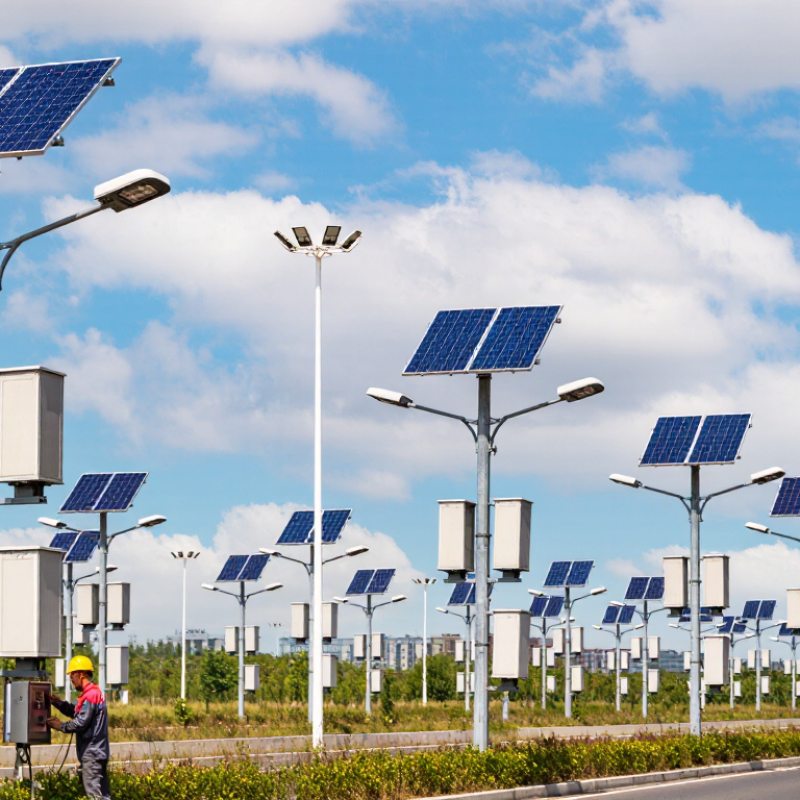
A commercial solar light pole supplier in China should do more than assemble a panel, battery, lamp, and pole. It should explain how these parts work together at a real site. The IEA’s 2022 report, Solar PV Global Supply Chains, found that China held over 80% of global manufacturing capacity across key solar-panel stages. Scale matters, but it does not prove a supplier can engineer reliable outdoor lighting. Ask for component traceability, production test records, and clear warranty terms. Details matter.
A capable supplier calculates lighting levels, battery autonomy, and pole loading for the project’s location. Ask how the system performs after several cloudy days, and request the assumptions behind the answer. Check test evidence for water and dust protection, corrosion resistance, and battery performance across expected temperatures. The IRENA Renewable Capacity Statistics 2024 report recorded 346 GW of new solar capacity worldwide in 2023, showing how quickly the wider sector is expanding. Yet a streetlight is not a solar farm. A polished datasheet can still omit practical limits, such as winter runtime or replacement access. Review a sample unit, inspect wiring and seals, and compare measured output with the specification before placing a large order.
A commercial supplier is best assessed by documented engineering capability, product testing, manufacturing controls, and project support—not by a universal ranking. Specifications should be matched to the installation site and project requirements.
| Evaluation Dimension | What Defines a Commercial-Capable Supplier | Evidence to Request |
|---|---|---|
| System design and sizing | Sizes the solar panel and battery using the luminaire load, operating hours, local solar resource, autonomy target, and expected seasonal conditions. | Project-specific load calculations, stated assumptions, panel and battery sizing, and an explanation of how the design accounts for lower-sunlight periods. |
| Lighting performance | Provides a defined lumen output, optical distribution, correlated colour temperature, and dimming schedule suitable for the intended road, car park, or site. | Photometric report or IES/LDT file, luminaire datasheet, and a lighting layout or simulation for the proposed installation. |
| Electrical and ingress protection | Specifies the luminaire, controller, connectors, and enclosure ratings clearly. IP ratings describe protection against ingress under defined test conditions. | Test documentation identifying the tested product and rating. For reference, IEC 60529 defines IP classification; IEC 60598-1 covers general luminaire safety requirements. |
| Solar module quality | Identifies the module type, rated power, dimensions, and electrical characteristics, with traceable product documentation. | Module datasheet and applicable test certificates. IEC 61215 addresses design qualification and type approval for terrestrial photovoltaic modules; IEC 61730 addresses PV module safety qualification. |
| Battery and charge control | States battery chemistry, nominal voltage and capacity, operating temperature limits, protection functions, and expected replacement considerations. | Battery datasheet, battery-management or protection details where applicable, controller specifications, and the assumptions behind any cycle-life or autonomy claims. |
| Pole structure and corrosion protection | Defines pole material, height, wall thickness, base-plate details, finish, and design loads for the project environment. | Dimensioned drawings, structural calculations or design criteria, material documentation, and galvanizing records where specified. ISO 1461 covers hot-dip galvanized coatings on fabricated iron and steel articles. |
| Wind and foundation suitability | Considers local wind conditions, pole geometry, mounted equipment, soil conditions, and foundation design rather than relying on pole height alone. | Project-specific wind-load assumptions, pole and base-plate calculations, anchor-bolt details, and foundation recommendations for review by the project engineer. |
| Manufacturing and quality control | Uses documented inspection steps for incoming components, fabrication, assembly, wiring, and final product testing. | Quality-management documentation, inspection records, production test procedures, and a clear process for handling non-conforming products. ISO 9001 concerns quality-management systems; it is not a product-performance certificate. |
| Standards and product testing | Identifies which standards apply to each component and provides reports that match the supplied model and configuration. | Relevant test reports and certificates with product identifiers, issuing laboratory, test scope, and dates. Road and street lighting luminaires may be assessed against IEC 60598-2-3 as applicable. |
| Customization and integration | Can coordinate pole dimensions, mounting brackets, panel orientation, luminaire options, controls, and project-specific finishes. | Approved drawings, bill of materials, interface details, sample or prototype approval process, and written confirmation of which options affect lead time or performance. |
| Warranty and serviceability | Provides clear warranty terms and designs the system so key components can be identified and replaced appropriately. | Written warranty scope and exclusions, spare-parts availability, troubleshooting guidance, and recommended inspection or maintenance procedures. |
| Export and project documentation | Can prepare consistent documentation for quotation, production approval, shipment, installation, and handover. | Commercial specification, packing details, installation instructions, wiring diagrams, component list, and agreed delivery and inspection milestones. |
Integrated manufacturers build the pole, panel, battery, controller, and LED as one system. Pole fabricators focus on structures, while specialist firms handle energy sizing and lighting performance. Export suppliers may combine products from several factories.
Ask for test data, production details, and clear information about how the components work together. A catalogue alone is not enough. Request evidence.
Pole fabricators focus on materials, base plates, and mounting details. Solar specialists should explain how sunlight, shade, winter conditions, and operating hours affect system capacity.
Look for panel output, battery chemistry, usable capacity, and expected autonomy. The proposal should also account for local sunlight, pole height, shading, and wind exposure.
A high lumen rating does not guarantee even coverage. Ask for a photometric file and a sample layout for the actual road or car park. Dark gaps matter.
Inspect welds, coating, cable protection, drainage, and battery access. Request relevant records for corrosion resistance, ingress protection, and structural loading.
Ask who is responsible for calculations, replacement parts, and site troubleshooting. Quality may vary between factories, so accountability should be clear in writing.
Run a small pilot and check illumination after several cloudy days. This may delay a larger order, but it can reveal problems early. It is not a perfect test.
Request installation drawings, commissioning guidance, spare-part information, and a written warranty with clear exclusions. Ask how cloudy-week performance and battery replacement are handled.
Compare the promised runtime with usable battery capacity and the site’s actual load. Ask for assumptions in writing. Some estimates may still be uncertain.
Choosing a Chinese supplier for Commercial Solar Light Poles involves more than comparing prices. Buyers should assess a supplier’s experience with commercial projects, manufacturing capacity, engineering expertise, and ability to provide reliable product documentation. Product quality depends on durable pole construction, suitable solar and battery components, consistent assembly, and performance testing. It is also important to confirm that products meet the technical and safety requirements applicable to the intended market.
Chinese suppliers vary in their strengths: some focus on large-scale manufacturing, while others offer customized designs, integrated lighting systems, or project-oriented technical support. Before making a selection, buyers should review specifications, quality-control processes, production lead times, warranty terms, communication practices, and after-sales service. A careful evaluation of these factors helps buyers identify a supplier that can meet project needs throughout design, delivery, installation, and ongoing operation.
