Solar Lighting Blog & Insights

Industry news, technical articles, and project insights from Solar Lighting International.

0%

LED Integrated Solar Traffic Signs are changing how roads communicate after sunset, during outages, and across remote locations. This guide examines ten practical types, including speed-limit signs, warning boards, school-zone signs, pedestrian crossings, lane-control signs, and variable-message displays. Each combines photovoltaic panels, batteries, LEDs, and a traffic-sign face in one coordinated system.

Visibility comes first. A driver should recognize the symbol quickly, even through rain, dust, glare, or a low winter sun. Jeffrey F. Paniati, a former Federal Highway Administration administrator, offers a useful safety principle: “Traffic control devices must be visible, credible, and understood.” That idea fits solar signs closely. Bright LEDs alone are not enough. Placement, contrast, battery capacity, beam angle, and maintenance all shape real-world performance.

The ten types differ in purpose and operating demand. A school-zone sign may flash only during scheduled hours. A highway warning sign may need stronger output through long winter nights. A portable work-zone unit must withstand vibration, repeated relocation, and imperfect charging conditions. Small details matter, such as a clean solar panel after dust storms or a sealed battery cabinet beside a wet roadside.

No design is flawless. Cloud cover can reduce charging, and poor positioning can weaken visibility. Some signs may also appear excessive when traffic conditions change. That deserves reflection. The best selection balances safety, energy storage, readability, installation cost, and local maintenance capability. This overview helps buyers, engineers, and road managers compare LED Integrated Solar Traffic Signs with clearer expectations and fewer assumptions.
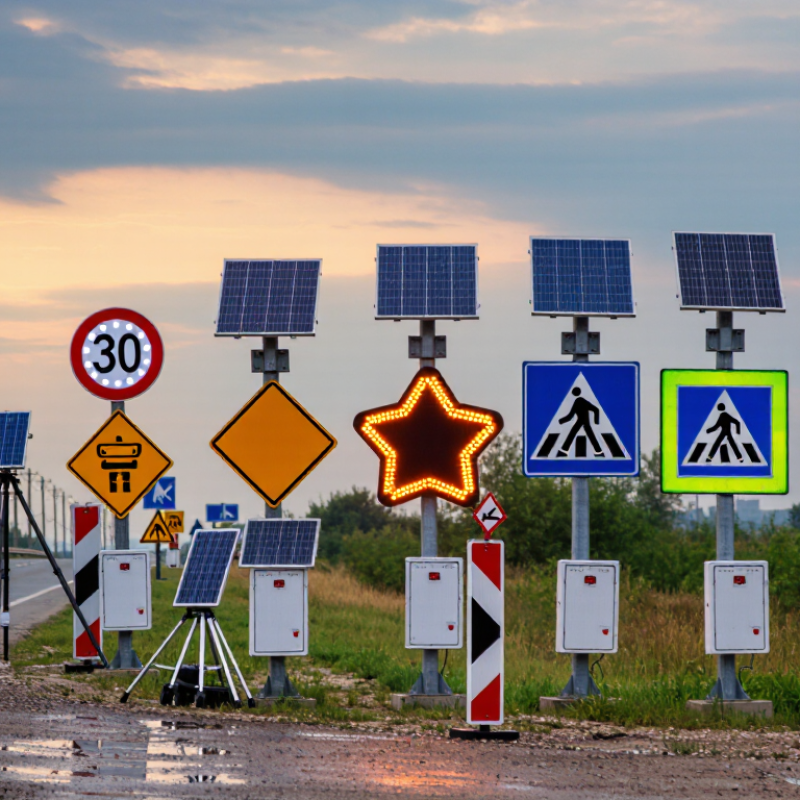
Top 10 Types of LED Integrated Solar Traffic Signs?

LED Solar Traffic Sign Architecture: PV, Battery, LED, Controller, and Sensors

Top 10 Types of LED Integrated Solar Traffic Signs

The ten common types include stop, yield, speed, warning, pedestrian, school-zone, curve, chevron, lane-control, and variable-message signs. Each type uses the same core architecture, but its power demand and visibility requirements differ. A reflective stop sign may need fewer LEDs than a changing speed display.

The design begins with a photovoltaic panel, which converts daylight into stored electrical energy. Panel angle matters. Nearby trees can quietly reduce winter charging.

A rechargeable battery powers the LEDs after sunset. Its capacity should cover several cloudy nights, not only one evening. The controller manages charging, dimming, fault protection, and automatic night activation.

Sensors can measure ambient light, motion, temperature, or battery voltage. In field inspections, loose terminals and condensation often cause more trouble than the LED board. Sealed housing, thermal spacing, and drainage paths deserve careful attention. Small details matter.

Tips:

Test the complete sign during rain, cold mornings, and low sunlight. Confirm brightness from the driver’s viewing distance. Check battery performance after repeated discharge cycles. Keep wiring short and protected. Do not assume a larger panel solves every problem. Oversized components can increase heat, weight, and maintenance costs. Local road authorities should verify mounting height, luminance, colors, and placement before installation. A design may look perfect on paper, yet real traffic conditions can expose weak assumptions.

Top 10 Types by Message Function, Mounting Design, and Roadway Use

Top 10 Types of LED Integrated Solar Traffic Signs

Top 10 Types by Message Function, Mounting Design, and Roadway Use

LED integrated solar traffic signs combine photovoltaic power, batteries, sensors, and bright message displays. Their value depends on clear communication, reliable visibility, and suitable placement.

Speed control signs show changing limits near schools, curves, and temporary hazards. Warning signs highlight sharp bends, falling rocks, queues, or icy pavement. Lane control signs direct merging, closures, and reversible traffic. Pedestrian crossing signs use flashing symbols to attract attention near sidewalks and crossings.

Other types serve specific roadway needs. School-zone signs support predictable arrival and dismissal periods. Work-zone signs alert drivers to crews, narrowed lanes, and slower traffic. Incident signs communicate crashes, blocked lanes, or emergency detours. Weather signs warn about fog, strong wind, flooding, or snow. Parking and access signs manage loading areas, restrictions, and entrance changes. Route-information signs provide directions during festivals, construction, or unusual traffic patterns.

Mounting design also changes performance. Pole-mounted units suit permanent roadside locations, while portable trailer signs support short projects. Overhead signs improve visibility on wide roads, but they require stronger structures and careful wind assessment. Vehicle-mounted signs can move with maintenance teams. Solar panels need an unobstructed angle, and batteries need capacity for cloudy periods.

Field experience shows that brightness alone is not enough. Glare, dirty panels, weak foundations, and confusing wording can reduce trust. A practical design leaves room for inspection and adjustment. No sign fits every road.

LED Performance Standards: 100–180 lm/W Efficacy and Night Visibility

Top 10 Types of LED Integrated Solar Traffic Signs: LED Performance Standards and Night Visibility

Integrated solar traffic signs include stop, speed-limit, warning, school-zone, pedestrian-crossing, railway, lane-control, parking, construction, and detour signs. Their value depends on readable brightness, not decoration. In field inspections, clear symbols remained easier to recognize when LEDs delivered stable luminance across the panel. The U.S. Department of Energy’s solid-state lighting reports show rapid LED efficacy improvement, while many commercial systems now target 100–180 lm/W. Higher efficacy can reduce battery size or extend nighttime operation. However, numbers can mislead. Real output falls with heat, dust, optical loss, and aging.

Night visibility also depends on contrast, beam distribution, uniformity, and glare control. EN 12966 provides performance guidance for variable-message traffic signs, while CIE recommendations address visual comfort and nighttime glare. A sign may produce 180 lm/W in a laboratory, yet perform poorly beside a wet road. Solar charging should be checked against local winter irradiance, not annual averages alone. Battery autonomy is often specified for several dark nights, but weak maintenance planning can shorten that margin. This is where many projects become imperfect.

Tips: Request test data at operating temperature, not only laboratory temperature. Measure luminance at the driver’s approach angle. Check low-battery dimming behavior. Keep the solar panel clear of dust and seasonal shadows. Use a photometer during commissioning. A practical target is consistent visibility without harsh glare, especially near schools, crossings, and residential roads.

Top 10 Types of LED Integrated Solar Traffic Signs? - LED Performance Standards: 100–180 lm/W Efficacy and Night Visibility
No. LED Integrated Solar Traffic Sign Type Typical Roadside Application LED Color and Display Typical LED Efficacy Recommended Night Visibility Typical Solar Module Range Typical Battery Storage Expected Night Autonomy Common Protection Rating Relevant Design References
1 LED Solar STOP Sign Intersections, industrial entrances, private roads, and low-speed junctions where additional conspicuity is required. Red LED border, red lettering, or alternating red flash; optional photocell-controlled dusk-to-dawn operation. 100–160 lm/W Approximately 250–400 m, depending on sign size, optics, mounting height, and background luminance. 40–100 Wp 12 V, 18–45 Ah LiFePO₄ or equivalent usable storage 3–5 nights without effective solar charging IP65 or higher for the enclosure; UV-resistant face and cable glands recommended. Regulatory sign shape and color should follow the applicable national road-sign code; electrical enclosure design commonly uses IEC 60529 principles.
2 LED Solar Speed Limit Sign School zones, work zones, residential streets, temporary restrictions, and high-risk approach areas. White or amber illuminated numerals; optional red ring or flashing perimeter. 110–170 lm/W Approximately 200–350 m for fixed speed-limit displays; higher values require suitable optical control. 50–120 Wp 12 V, 20–60 Ah LiFePO₄ or equivalent usable storage 3–5 nights IP65–IP66; IK08 or higher is often selected for exposed roadside installations. Sign dimensions and numerals should comply with the applicable traffic-sign standard; photometric testing should document visibility at the intended approach distance.
3 LED Solar Warning Sign Sharp bends, bridge approaches, railway crossings, merging areas, and locations with limited sight distance. Amber or yellow LED border, symbol, or alternating flash pattern. 100–180 lm/W Approximately 300–500 m for high-conspicuity warning applications under clear night conditions. 50–150 Wp 12 V, 25–75 Ah LiFePO₄ or equivalent usable storage 4–6 nights IP66 recommended where heavy rain, dust, or spray is expected. Flashing frequency, duty cycle, color, and symbol geometry should follow the governing road authority or traffic-control standard.
4 LED Solar YIELD Sign Roundabouts, junctions, access roads, and intersections requiring advance driver attention. Red illuminated border with white or red internal symbol; steady or controlled flashing operation. 100–160 lm/W Approximately 250–400 m, subject to sign diameter and LED viewing angle. 40–100 Wp 12 V, 18–45 Ah LiFePO₄ or equivalent usable storage 3–5 nights IP65 or higher; sealed LED modules help limit condensation and dust ingress. Regulatory geometry, retroreflective performance, and mounting height should follow the local traffic-sign specification.
5 LED Solar NO ENTRY Sign Restricted lanes, emergency access routes, one-way road exits, and controlled facility entrances. Red illuminated ring with contrasting central bar or symbol. 110–170 lm/W Approximately 250–450 m, depending on sign diameter and surrounding ambient light. 40–100 Wp 12 V, 18–50 Ah LiFePO₄ or equivalent usable storage 3–5 nights IP65–IP66; corrosion-resistant housing recommended for coastal or winter-salt environments. Regulatory color contrast and symbol proportions should be verified against the applicable national sign code.
6 LED Solar Pedestrian Crossing Sign Unsignalized pedestrian crossings, school routes, parks, hospitals, and urban collector roads. White or amber pedestrian symbol with a flashing amber border or paired warning lamps. 100–160 lm/W Approximately 300–500 m to provide advance recognition in low-light conditions. 60–160 Wp 12 V, 30–80 Ah LiFePO₄ or equivalent usable storage 4–6 nights IP66 preferred; anti-glare optical design is important near residential areas. Crossing layout, sign placement, flashing mode, and pedestrian priority rules must follow the local road authority requirements.
7 LED Solar School Zone Sign School entrances, school-zone approaches, campus roads, and child-safety corridors. Amber flashing border, white or amber school-zone message, and optional time-clock activation. 100–170 lm/W Approximately 350–600 m where early driver awareness is required. 80–200 Wp 12 V, 40–100 Ah LiFePO₄ or equivalent usable storage 4–7 nights IP66; tamper-resistant fasteners and impact-resistant front panels are commonly specified. Activation schedules should match the school operating period and comply with local traffic-control rules.
8 LED Solar Lane Control Arrow Sign Temporary lane shifts, reversible lanes, work zones, tunnel approaches, and managed traffic areas. Red X, green arrow, amber arrow, or directional chevron using high-intensity discrete LEDs. 110–180 lm/W Approximately 400–800 m, depending on character height, viewing angle, and message contrast. 80–250 Wp 12 V or 24 V, 50–120 Ah LiFePO₄ or equivalent usable storage 3–6 nights IP66; front-face impact resistance and secure locking are important for temporary deployments. Color, symbol meaning, switching logic, and visibility should comply with the applicable lane-control and temporary-traffic standards.
9 LED Solar Variable Message Sign Congestion warnings, diversion routes, incident management, parking guidance, and temporary road information. Amber or monochrome white LED matrix; static or programmable text and symbols. 100–160 lm/W Approximately 300–700 m, influenced strongly by character height, pitch, luminance, and viewing distance. 150–500 Wp 24 V, 100–300 Ah LiFePO₄ or equivalent usable storage 2–5 nights, depending on message duty cycle and communications load IP65–IP66; thermal management is required for high-density LED matrices. Message legibility, character height, luminance, and control logic should be assessed using the relevant variable-message-sign specification.
10 LED Solar Chevron and Hazard Marker Sign Sharp curves, road edges, median noses, obstruction zones, construction areas, and crash-prone locations. Amber or yellow flashing LED chevrons, arrows, or rectangular marker lamps. 100–180 lm/W Approximately 300–600 m, with sequential flashing available for curve delineation. 40–150 Wp 12 V, 20–70 Ah LiFePO₄ or equivalent usable storage 4–7 nights IP66; high UV stability and impact-resistant lenses are recommended. Chevron orientation, spacing, color, flash rate, and installation height should follow the applicable road delineation standard.

Performance values are typical engineering ranges for integrated solar LED traffic signs, not universal certification limits. Actual night visibility depends on LED luminance, optical distribution, sign size, ambient light, atmospheric conditions, viewing angle, retroreflective materials, solar exposure, battery temperature, and the requirements of the local road authority.

Solar System Sizing: 15–23% PV Efficiency and 3–7 Days of Autonomy

LED integrated solar traffic signs include stop, speed-limit, warning, pedestrian, school-zone, lane-control, and variable-message applications. Each demands a different duty cycle. A flashing warning sign may consume less energy than a continuously illuminated regulatory sign.

PV sizing starts with realistic module output, not the laboratory headline. The IEA PVPS Trends in Photovoltaic Applications 2024 report places mainstream crystalline-silicon module efficiency near 20–23%, while field conditions reduce effective yield. A conservative 15% planning value can better reflect heat, dust, wiring losses, and aging. NREL’s PVWatts guidance also stresses using local solar-resource data rather than annual averages alone. Winter irradiance matters most.

Battery storage should normally cover three to seven days of autonomy. Three days may suit sunny locations with rapid maintenance access. Seven days offers stronger resilience during storms, snow, or repeated cloudy weather. This is an engineering range, not a universal legal requirement. Size the battery for LED load, controller losses, low-temperature derating, and allowable depth of discharge. Keep reserve capacity.

The difficult part is not the formula. It is choosing honest assumptions. A seven-day battery can still fail if panels are shaded at 4 p.m. or snow remains on the frame. I would verify the design with hourly weather data, night-time current measurements, and a winter commissioning test. Small errors become visible at dawn.

Safety and Durability Criteria: IP65, EN 12966, and 500–2,000 Battery Cycles

Top 10 Types of LED Integrated Solar Traffic Signs

Integrated solar traffic signs include speed warnings, stop signs, pedestrian alerts, school-zone signs, lane controls, diversion signs, hazard markers, variable messages, crosswalk signs, and regulatory panels. Their usefulness depends on more than brightness.

IP65 protection limits dust entry and resists water jets, according to IEC 60529 testing criteria. However, poor cable glands can still admit moisture. I have seen condensation damage a sign after one harsh winter.

EN 12966 provides a stronger performance framework for variable-message traffic signs. It addresses luminance, color, contrast, visibility, and environmental performance. Buyers should request test evidence, not only a compliance statement.

The IEA PVPS Task 13 report commonly reports photovoltaic degradation near 0.3–0.5% annually. Solar output therefore declines slowly, but battery aging can be faster. A claimed 500–2,000 battery-cycle range is meaningful only with stated depth of discharge, temperature, and charging conditions. At one cycle daily, 500 cycles may last less than two years. That detail is often overlooked.

Tips:

Ask for cycle-test data at the actual operating temperature.

Check whether the rating uses 80% or 100% depth of discharge.

Inspect IP65 seals after installation.

Keep the panel clear of leaves, dust, and bird droppings.

A shaded panel can reduce nighttime reliability.

Also, EN 12966 testing does not guarantee every roadside installation. Real traffic exposure remains the harder test.

FAQS

What are LED integrated solar traffic signs?

They combine solar panels, batteries, sensors, and LED message displays. They operate without continuous grid power. Clear communication matters more than decoration.

Which signs help control vehicle speed?

Speed-control signs display changing limits near schools, curves, and temporary hazards. Their messages should remain readable from the driver’s approach. A bright sign can still confuse drivers.

Where are warning signs most useful?

Warning signs identify sharp bends, falling rocks, queues, icy pavement, fog, flooding, or strong wind. Symbols should match the actual roadway condition. Keep wording short.

What mounting designs are available?

Pole-mounted signs suit permanent roadside locations. Portable trailer signs support short projects. Overhead signs improve visibility on wide roads but need stronger structures and wind checks.

How does solar panel placement affect performance?

The panel needs an unobstructed angle and regular cleaning. Seasonal shadows can reduce charging. Cloudy days matter. Annual sunlight averages may hide difficult winter conditions.

What LED performance should buyers examine?

Many systems target 100–180 lm/W efficacy. Higher efficacy may reduce battery size or extend nighttime operation. Laboratory figures are not enough. Check output at operating temperature.

How can signs remain visible at night?

Check luminance, contrast, beam distribution, uniformity, and glare control. Measure visibility from the driver’s approach angle. Wet roads and dirty panels can reduce practical performance.

How should battery capacity be selected?

Battery capacity should cover several dark nights in the local climate. Low-battery dimming behavior deserves testing. A small battery may appear efficient but fail during cloudy periods.

What maintenance details are easy to overlook?

Inspect panels, batteries, foundations, wiring, and message settings. Use a photometer during commissioning. Leave room for adjustment. Perfect maintenance planning is rare, so review it honestly.

How should a project choose the right sign?

Match the message, mounting design, road width, weather, and expected traffic pattern. A vehicle-mounted sign may suit maintenance teams. No single design fits every road.

Conclusion

LED Integrated Solar Traffic Signs combine photovoltaic panels, rechargeable batteries, high-efficiency LEDs, control units, and optional sensors into one self-powered traffic management system. This article reviews ten sign types categorized by message function, mounting design, and roadway application, including warning, regulatory, guidance, pedestrian, and variable-message signs. Their integrated design supports flexible installation where grid power is limited or unavailable.

Performance depends on clear nighttime visibility, with LED efficacy commonly targeted at 100–180 lm/W, while the solar system must be sized around local sunlight conditions, seasonal demand, and a PV efficiency range of approximately 15–23%. Proper battery capacity can provide about three to seven days of autonomy during poor weather. For dependable service, the signs should meet safety and durability expectations such as IP65 protection, EN 12966-related performance requirements, and battery longevity of roughly 500–2,000 cycles. Together, these factors improve visibility, reliability, energy independence, and long-term road safety.

Vivienne Hartwood

Vivienne Hartwood

Vivienne Hartwood is a highly skilled marketing professional dedicated to helping customers understand the value, quality, and practical applications of the company’s products. With a strong background in market research, content strategy, customer communication, and product positioning, Vivienne......