
Industry news, technical articles, and project insights from Solar Lighting International.
Flooding can change a quiet street within minutes. Rising water may cover roads, damage equipment, isolate communities, and threaten critical infrastructure. Solar High Water Flood Detection Systems offer a practical way to monitor these changes where grid power is unavailable or unreliable. Their panels, batteries, sensors, and wireless transmitters can support continuous observation with limited maintenance.
This guide examines ten systems designed for high-water and flood detection. The comparison considers sensing accuracy, alert speed, solar performance, battery endurance, installation demands, communication range, and data access. It also considers field realities, such as mud-covered sensors, weak cellular signals, heavy rain, and winter sunlight. These details matter more than impressive specifications alone. A dependable system should provide clear alerts, protect outdoor components, and remain understandable during stressful conditions.
The assessment draws on engineering principles, manufacturer documentation, and practical monitoring needs. However, published performance figures do not always match difficult sites. Local terrain, debris, water chemistry, and maintenance habits can change results. No system is perfect. That limitation deserves attention. A sensor mounted too close to a drainage channel may trigger false alarms. A small solar panel may struggle after several cloudy days. Readers should verify certifications, warranty terms, installation requirements, and regional communication compatibility before purchasing. The best choice is not always the most advanced model. It is the system that delivers trustworthy warnings when people need them most.
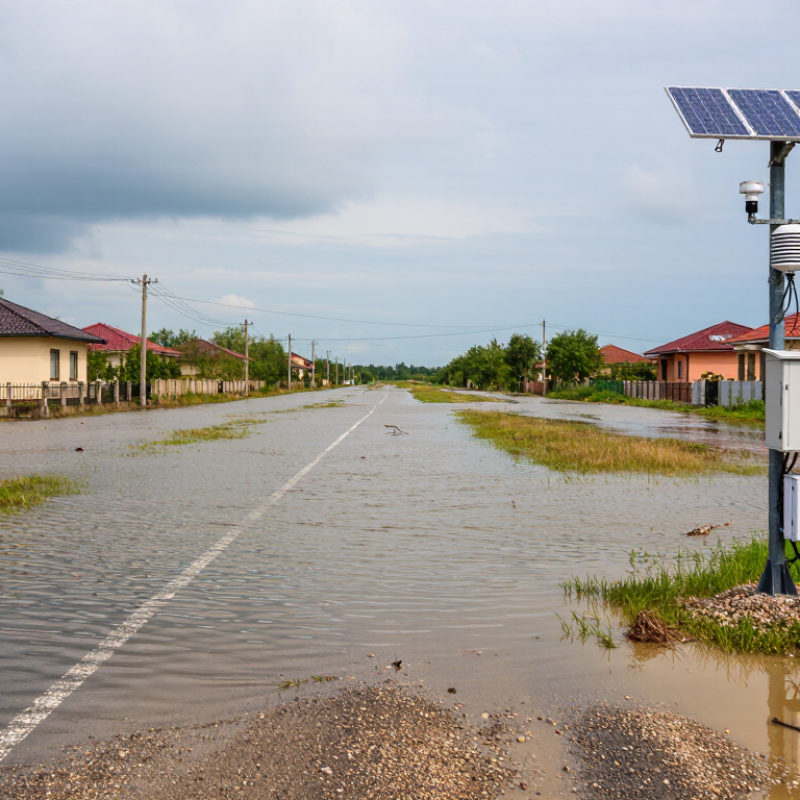
Solar-powered high-water flood detection systems are remote monitoring devices that measure rising water levels without relying on grid electricity. A solar panel charges a battery during daylight. The battery powers sensors, data storage, and wireless communication. Common sensors include ultrasonic, pressure, and float-based devices. Each type responds differently to debris, foam, temperature, and fast-moving water.
A typical system mounts beside a drain, river, culvert, or retention basin. The sensor records water height at set intervals. When the level reaches a programmed threshold, it sends an alert through a cellular, radio, or satellite network.
Enclosures should resist rain, dust, insects, and accidental impact. Accurate installation matters. A poorly aligned sensor can report safe conditions during a dangerous rise.
Field maintenance remains essential, even with solar power. Technicians should inspect panels, clean sensor surfaces, test batteries, and verify alert delivery. Shade from growing trees can reduce charging performance. Heavy rain may also carry mud that blocks measurement points. These systems are useful, but they are not flawless. Communication outages can delay warnings. Thresholds may need adjustment after local flooding. I would treat automated alerts as an early signal, not a substitute for site inspections, emergency planning, or professional hydrological assessment.
Top 10 Solar High Water Flood Detection Systems
How Solar Flood Detection Systems Monitor Rising Water Levels
Solar flood detection systems track water movement in areas without dependable grid power. A solar panel charges a battery during daylight. Sensors then measure water height through the night. Ultrasonic sensors read the distance from a mounting point to the surface. Pressure sensors detect water depth from below. Some installations use a float switch as a simple backup.
When the water rises, the controller compares readings with preset warning levels. It can send alerts through cellular, radio, or satellite communication. A useful system records time, depth, battery voltage, and signal strength. This data helps emergency teams see whether flooding is accelerating. Placement matters greatly. A sensor beside a bridge may face waves, debris, and reflected echoes. A quiet drainage channel may provide cleaner measurements.
Tips: Mount equipment above the highest expected flood mark. Shield cables from animals and standing water. Clean the sensor face after storms. Test alerts monthly. Do not trust one reading blindly. Rain, mud, fog, and floating branches can create false alarms. Field teams should compare sensor data with a marked staff gauge when possible. No setup is perfect. Even well-designed systems may miss a rapid rise if communication fails or the battery remains poorly charged. Reviewing these weak points keeps monitoring practical and safer.
| Rank | Solar Flood Detection System Type | Primary Water-Level Sensor | Typical Measurement Range | Solar Power Configuration | Backup Battery | Communication Method | Alert and Monitoring Function | Typical Accuracy | Recommended Deployment |
|---|---|---|---|---|---|---|---|---|---|
| 1 | Solar Ultrasonic Level Monitoring Station | Non-contact ultrasonic sensor mounted above the water surface | 0.3–10 m, depending on sensor model and installation height | 20–50 W photovoltaic panel with a charge controller | 12 V, 7–20 Ah sealed lead-acid or lithium battery | 4G LTE / LTE-M | Scheduled water-level readings, configurable high-water thresholds, remote dashboard, and SMS or email alarms | Typically ±0.25% to ±1% of the measuring range | Open channels, drainage canals, detention ponds, and riverbanks where contact with water should be avoided |
| 2 | Solar Radar Water-Level Station | Non-contact microwave radar level sensor | 0.5–20 m or more, according to antenna and sensor configuration | 30–80 W photovoltaic panel with regulated charging | 12 V or 24 V rechargeable battery sized for several days of autonomy | 4G LTE / NB-IoT | Continuous or interval measurement, trend analysis, threshold alerts, and remote device diagnostics | Typically ±2–10 mm for suitable installations | Fast-flowing rivers, locations with foam or debris, and sites exposed to rain, dust, or temperature changes |
| 3 | Solar Submersible Pressure Transmitter System | Vented or absolute pressure transducer installed below the water surface | 0–3 m, 0–10 m, or 0–30 m water column ranges are common | 10–40 W photovoltaic panel with low-power data logger | 12 V, 7–18 Ah battery with multi-day backup | LoRaWAN / 4G | Water-depth logging, rapid-rise detection, programmable sampling intervals, and cloud reporting | Typically ±0.1% to ±0.25% of full scale | Flood wells, culverts, tanks, canals, and locations where the sensor can be securely submerged |
| 4 | Solar Float-Switch Flood Alarm | Mechanical float switch or magnetic reed switch at one or more elevations | Fixed alarm points rather than continuous depth measurement; commonly 0.1–2 m | 5–20 W photovoltaic panel | 12 V, 4–12 Ah rechargeable battery | GSM / 4G | Immediate alarm when water reaches a preset level; simple relay output for sirens, beacons, or pumps | Generally determined by installation height; switching repeatability is commonly within a few millimeters | Small flood-prone sites, pump stations, basements, roadside drains, and emergency overflow points |
| 5 | Solar LoRaWAN Water-Level Sensor Network | Ultrasonic, pressure, or radar sensor connected to a low-power LoRaWAN node | Approximately 0.2–10 m, depending on the attached sensor | 5–30 W photovoltaic panel for the node and sensor assembly | Rechargeable lithium battery, commonly 3.6–12 V | LoRaWAN | Low-power periodic reporting, gateway-based aggregation, geofenced alerts, and multi-site flood mapping | Sensor-dependent; commonly ±0.5% to ±1% of full scale | Large drainage basins, agricultural areas, municipal sensor networks, and sites with a nearby gateway |
| 6 | Solar Camera-Based Flood Observation Unit | Fixed camera using a calibrated reference staff, marker, or image-analysis algorithm | Commonly 0–5 m of visible reference scale | 50–150 W photovoltaic panel, depending on image frequency and lighting | 20–100 Ah battery bank for night operation and cloudy periods | 4G LTE | Time-lapse images, visual verification of flooding, optional automated level estimation, and event-based alerts | Typically ±1–5 cm when the reference scale is clearly visible | Bridges, road crossings, river gauges, remote infrastructure, and sites requiring visual confirmation |
| 7 | Solar Multi-Point Conductive Water Detector | Stainless-steel or corrosion-resistant electrodes positioned at several height levels | Discrete levels, commonly 0.05–1.5 m above the lowest electrode | 5–15 W photovoltaic panel | 12 V, 4–12 Ah rechargeable battery | GSM / LoRaWAN | Detects contact with water at predefined heights and sends staged warning notifications | Level resolution is defined by electrode spacing; typical step size is 5–20 cm | Underpasses, storm drains, utility chambers, low-lying roads, and locations with muddy or obstructed surfaces |
| 8 | Solar Pressure-Bubbler Gauge | Air bubbler tube with a pressure sensor positioned outside the water | 0–3 m, 0–10 m, or higher water-column ranges | 20–60 W photovoltaic panel with a low-power compressor | 12 V, 12–40 Ah battery | 4G LTE / Satellite | Continuous or scheduled river-stage measurement, data logging, threshold alarms, and remote telemetry | Typically ±0.1% to ±0.25% of full scale after calibration | Rivers with sediment, debris, or difficult access where the pressure sensor should remain above the water |
| 9 | Solar IoT Flood Gateway with Multiple Sensors | Combination of water-level, rainfall, soil-moisture, and flow sensors | Water-level range commonly 0.2–10 m; other sensors are site-specific | 40–120 W photovoltaic panel with a regulated DC power system | 20–100 Ah lithium or deep-cycle battery bank | 4G LTE / Ethernet / LoRaWAN | Combines rising-water data with rainfall and flow conditions for early-warning rules and network-wide monitoring | Depends on each connected sensor; level sensors commonly provide ±0.5% to ±1% of full scale | Municipal flood-warning networks, watersheds, industrial sites, and critical infrastructure corridors |
| 10 | Solar Satellite Flood Monitoring Station | Pressure, ultrasonic, or radar level sensor paired with a satellite telemetry terminal | Typically 0–10 m, with larger ranges available for deep channels | 40–100 W photovoltaic panel sized for sensor and satellite transmissions | 20–100 Ah battery bank for extended autonomy | Satellite IoT | Remote water-level reporting, high-water alarms, position monitoring, and operation without cellular coverage | Sensor-dependent; commonly ±0.25% to ±1% of full scale | Remote rivers, mountain valleys, coastal wetlands, islands, and areas without dependable cellular networks |
Comparing the top 10 solar high-water flood detection systems requires more than checking panel size. The World Meteorological Organization reported that only about one-third of global river basins had normal conditions in 2023. This strengthens the case for dependable, remote monitoring. Solar autonomy should be measured in cloudy-day endurance, not only peak wattage. I would examine battery capacity, charge control, low-power operation, and winter performance. Small details matter.
Each system should be scored for sensor accuracy, detection speed, and installation height. Radar, pressure, and ultrasonic sensors behave differently around debris, foam, and moving water.
The World Meteorological Organization’s 2024 flood guidance stresses timely observations and reliable data exchange. Therefore, useful systems need cellular, satellite, or long-range radio options.
They should also provide local alarms when communications fail. Waterproof housing should meet a documented ingress standard, such as IEC 60529. Testing evidence is more valuable than marketing language.
Maintenance separates promising equipment from field-ready equipment. Compare calibration intervals, battery replacement time, dashboard clarity, and open data formats. The United Nations Office for Disaster Risk Reduction estimated disaster losses at roughly 2.8 trillion dollars from 2000 to 2019, showing the cost of weak preparedness.
Still, no scorecard is perfect. A cheaper sensor may outperform an expensive unit in a narrow drainage channel. False alarms deserve equal attention. I would record real rainfall events, inspect the mounting pole, and review missed warnings before assigning final rankings.
Solar high-water flood detection systems use sunlight to monitor rising water without relying on mains electricity. They suit drainage channels, farms, roads, basements, and remote communities. The best choice depends on water depth, communication range, maintenance access, and local weather.
Ultrasonic sensors measure the distance to the water surface without contact.
Pressure sensors detect water weight at a fixed depth.
Float switches provide simple, reliable threshold alerts.
Conductive probes identify water touching electrical contacts.
Radar sensors measure levels through rain, darkness, and light surface movement.
Optical sensors detect changes in light caused by rising water.
Camera-based systems capture visual evidence, although poor visibility can reduce accuracy.
Acoustic sensors use sound patterns to estimate water movement.
Cellular systems send alerts through mobile networks.
Satellite-linked systems support isolated sites beyond cellular coverage.
A practical installation needs a solar panel, battery, controller, sensor, and communication unit. Place the panel above expected flood height. Protect cables from animals, debris, and standing water. Test alerts during dry weather, not only during emergencies.
Field inspections often reveal blocked sensors, weak signals, or batteries drained by cold nights. No design is flawless. A radar unit may resist contact damage but cost more. A float switch is affordable, yet debris can hold it down.
I would also question any system promising instant detection everywhere. Solar charging varies with shade, storms, and seasonal daylight. Regular cleaning and recorded test results make the warning data more trustworthy.
For a top-ten shortlist, flood detection starts with site risk, not the solar panel. NOAA’s 2024 Billion-Dollar Disasters report recorded 27 U.S. events, showing why earlier warnings matter. The IPCC Sixth Assessment Report also identifies increasing heavy precipitation in many regions. Rank each detector by sensing depth, alert reliability, battery reserve, enclosure protection, and data logging. Not always economical. A quiet basement can flood quickly.
Mount the sensor at the lowest realistic water-entry point, above routine splash. Use two sensing heights where false alarms could disrupt operations. Keep the panel unshaded around midday. Aim it toward the local winter sun, not simply along the roof slope.
Seal cable entries carefully. IEC 60529-rated protection helps, but labels are not guarantees. Leave safe access around the sensor. Test alarms with clean water, never near energized equipment.
The World Meteorological Organization’s State of the Global Climate 2023 documents severe climate extremes and serious flood impacts. That supports regular maintenance, not blind automation. Inspect the probe, panel, battery terminals, and communication link monthly. Clear mud, insects, leaves, and mineral film.
Test it monthly. Record signal strength and alert time. A 72-hour battery reserve is practical during cloudy weather, but local sunlight and power demand matter.
Replace batteries by measured capacity, not age alone. A detector may sense water accurately yet fail when communications collapse.
Add a local siren or visible beacon. Review the system after every major storm; early installations are sometimes mounted too close to drains.
A solar panel charges a battery during daylight. Sensors measure water height through the night. Ultrasonic sensors measure surface distance from above. Pressure sensors measure depth from below. A float switch can provide simple backup.
The controller compares readings with preset levels. It may send alerts by cellular, radio, or satellite links. Useful records include water depth, time, battery voltage, and signal strength. A local alarm helps when communication fails.
Place it near the lowest realistic water-entry point. Keep it above routine splashes. A bridge may create waves and reflected echoes. A quiet drainage channel may produce cleaner readings. Site choice matters more than panel size.
Rain, mud, fog, foam, and branches can confuse sensors. Use two sensing heights when false alarms could cause trouble. Compare readings with a marked staff gauge. Do not trust one reading blindly. I sometimes would.
Check battery capacity, charging control, and cloudy-day endurance. Peak panel wattage is not enough. A 72-hour battery reserve can help during dark weather. Winter sunlight and local power demand still matter. Small details matter.
Mount the enclosure above the highest expected flood mark. Seal cable entries carefully. Shield cables from animals and standing water. Keep the panel unshaded around midday. Waterproof labels are not guarantees.
Inspect the probe, panel, battery terminals, and communication link monthly. Remove mud, insects, leaves, and mineral film. Test alerts with clean water, away from energized equipment. Record signal strength and alert time. Do not skip this.
Yes. Communication may collapse, or the battery may remain poorly charged. A rapid rise can also exceed the warning system’s response time. Review every major storm afterward. The first installation may be too close to a drain.
Solar High Water Flood Detection Systems are solar-powered devices designed to identify rising water levels in locations without dependable grid electricity. They typically combine water-level sensors, a solar panel, rechargeable battery, local alarms, and wireless communication to provide timely warnings. As water rises, the sensor measures changes and sends alerts through visual, audible, or remote notification methods, helping property owners, communities, and facility managers respond before flooding causes serious disruption.
The top systems can be compared by detection accuracy, alert speed, power autonomy, communication range, weather resistance, installation flexibility, data access, and maintenance requirements. Selecting the right solution depends on the site’s flood risk, expected water depth, signal availability, and monitoring needs. Proper installation should place the sensor where water can reach it safely while keeping the solar panel unobstructed. Regular cleaning, battery checks, sensor testing, and inspection after severe weather help maintain reliable performance and extend the system’s service life.