
Engineered with zero-uplight cutoff optical geometry, high-efficacy LED modules, and smart MPPT charging for global infrastructure project compliance.
A technical treatise on optical cutoffs, BUG ratings, spectral management, and off-grid reliability for municipal and enterprise procurement.
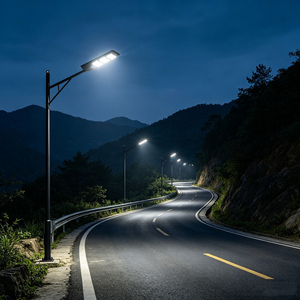
As light pollution escalates globally at an estimated 9.6% annual rate, international municipalities, civil planners, and corporate developers strictly enforce International Dark-Sky Association (IDA) standards. Achieving true Dark Sky compliance requires holistic optical engineering rather than simple downward tilting. Solar luminaires must guarantee a Uplight Rating of U=0 within the IESNA BUG (Backlight, Uplight, Glare) rating system.
Our engineered solar street lights and floodlights incorporate custom-molded PMMA refractive lenses paired with physical cut-off visors. This ensures 100% of emitted light vectors fall between 0° and 80° relative to the nadir. By completely suppressing light spill above 90°, our fixtures eliminate atmospheric skyglow, protect nocturnal ecosystems, and satisfy strict municipal outdoor lighting ordinances across North America, Europe, and the Middle East.
Traditional high-CCT outdoor lighting (5000K–6500K) emits excessive blue light wavelength spikes (450nm–480nm). High-energy blue photons scatter far more intensely in the atmosphere due to Rayleigh scattering, exacerbating glare and disrupting human circadian rhythms and wildlife behavior. Our enterprise Dark Sky solar lighting ranges prioritize warm CCT configurations: 2200K, 2700K, and 3000K.
By pairing low-blue LED arrays with high color rendering indices (CRI > 80), our commercial solar fixtures deliver exceptional target visual acuity while mitigating blue-light scattering. Furthermore, our optical drivers maintain constant spectral output even when operating on dimmed battery profiles during low-solar-harvest winter cycles.
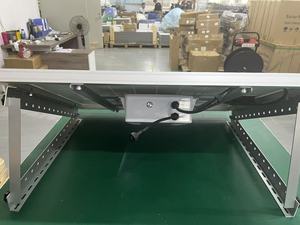
Combining tier-1 photovoltaic panels, LiFePO4 battery management systems, and precision die-cast enclosures.
Utilizing premium grade-A N-Type monocrystalline cells delivering up to 23.5% solar conversion efficiency. Optimized for maximum spectral reception under diffuse sunlight and high operating temperatures.
Equipped with automotive-grade Lithium Iron Phosphate (LiFePO4) battery packs managed by smart BMS cards. Offering over 4,000 deep discharge cycles @ 80% DOD with an extended 8 to 10-year design life.
Maximum Power Point Tracking algorithms achieving 99% tracking efficiency. Automatically dynamically adjusts voltage ratios based on ambient temperature, state of charge, and cloud cover patterns.
Architectural-grade ADC12 aluminum housings finished with electrostatically applied anti-corrosion powder coating. Tested for 1,000-hour ASTM B117 salt spray resistance and high wind load durability.
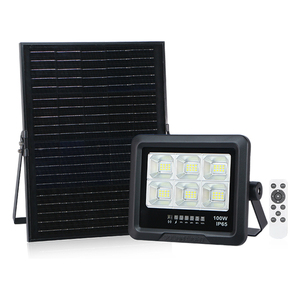
Precision acrylic optics custom-molded for specific roadway geometries (Type II/III) and broad parking/security illumination (Type IV/V), maximizing pole spacing while eliminating hotspot glare.
Optional Zhaga / NEMA socket integration supporting LoRaWAN, NB-IoT, and Zigbee wireless controllers for real-time remote monitoring, adaptive dimming schedules, and automated error diagnostics.
Key market factors, legislative mandates, and total cost of ownership (TCO) shifts influencing B2B purchasing decisions.
Global commercial enterprises and municipal tenders increasingly require third-party environmental product declarations (EPDs). Procurement directors are shifting away from grid-tied LED retrofits toward completely zero-emission solar systems. By eliminating underground trenching, copper wiring, and utility grid draw, off-grid solar street lights cut initial capital expenditure (CAPEX) by 30-50% while delivering verifiable scope 1 and scope 2 carbon reduction metrics for annual ESG reporting.
Regulatory authorities in North America (IDA standards), Europe (EN 13201-2), and Australasia are mandating zero-uplight requirements for all new commercial exterior lighting installations. Future procurement specifications require suppliers to provide full IES LM-79-19 test reports proving U=0 performance, CCT values under 3000K, and optical shielding preventing light trespass into adjacent residential properties and ecological reserves.
B2B importers and project contractors are rejecting single-use integrated lights with non-replaceable battery packs. Sourcing trends heavily favor modular luminaires where LiFePO4 battery modules, MPPT drivers, and LED PCB boards can be independently accessed and replaced in the field. This modularity extends total system service life beyond 15–20 years, dramatically reducing operational maintenance cost profiles.
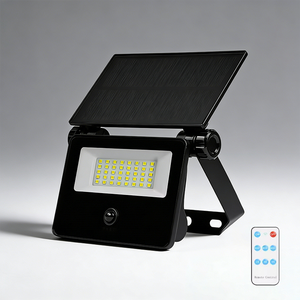
Modern commercial specifications demand self-learning luminaire controllers. Modern MPPT systems track historical weather patterns, battery state of health (SOH), and seasonal day-length shifts. By dynamically modulating luminous output based on real-time occupancy data (PIR/Microwave radar) and predictive solar harvesting forecasts, solar lights ensure 100% continuous nocturnal operation even during extended 5-day rain events.
Next-generation material science and optical breakthroughs redefining off-grid illumination performance.
The solar lighting industry is on the verge of a efficiency leap with the commercialization of Perovskite-Silicon Tandem Solar Cells. Standard silicon cells hover around 20-23% efficiency, whereas commercial tandem cell modules promise operational efficiencies exceeding 28-30%. For all-in-one solar street lights, this means a 30% reduction in solar panel surface area without sacrificing daily energy harvest—allowing sleeker, lower-wind-resistance fixture designs.
While LiFePO4 batteries excel in standard climates, extreme environments (-30°C in Nordic winters or +65°C in Middle Eastern deserts) push liquid electrolyte lithium batteries to their physical limits. Future solar luminaires are adopting solid-state battery technology. Solid-state architectures eliminate thermal runaway risks, double volumetric energy density, and allow full operational capacity across extreme temperature spans from -40°C to +85°C without auxiliary heating elements.
Advanced optical engines will move beyond static 3000K warm CCT lighting toward dynamically adaptive spectral management. Smart solar luminaires will broadcast warm, low-intensity 2200K amber lighting during low-traffic overnight hours to protect nocturnal fauna, then rapidly shift to high-definition 3000K 90-CRI light upon detecting high-speed vehicle or pedestrian motion. This maximizes energy conservation while optimizing public safety.
Robust manufacturing infrastructure, ISO 9001:2015 quality gates, and comprehensive OEM/ODM global export support.
We provide enterprise clients, engineering consultants, and municipal buyers with complete Dialux EVO lighting simulation designs and certified IES files to verify illuminance (Lux), uniformity (U0), and zero-uplight compliance before ordering.
Every luminaire undergoes rigorous testing: 100% automatic optical inspection (AOI), high-voltage isolation tests, integrating sphere spectral measurement, IP67 waterproof chamber immersion, and a continuous 48-hour burn-in cycle prior to shipment.
Fully certified to meet CE, RoHS, CB, IEC 62722, IEC 62133 (Battery Safety), UN38.3, and Dark Sky IDA standards. We maintain robust raw material supply contracts to guarantee stable lead times and competitive volume pricing.
Addressing key technical, regulatory, and logistics queries for international B2B buyers and project contractors.
Partner with China's top Dark Sky compliant solar lighting manufacturer. Connect with our senior engineering team to discuss specs, customized OEM solutions, and bulk project discounts.