
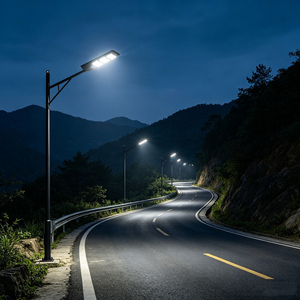
Direct from top-tier ISO 9001:2015 certified production lines: Field-tested perimeter security, highway floodlighting, and autonomous commercial luminaires engineered for 20+ year operational lifespans.
An in-depth technical analysis for EPC contractors, municipal engineers, and procurement directors evaluating off-grid security lighting assets.
Traditional AC-powered perimeter floodlighting carries exorbitant civil engineering overheads. Grid-tied infrastructure requires ground trenching, conduit laying, wire pulling, and transformer step-downs—costing between $30 to $75 per linear foot. Commercial solar security floodlights operate as fully autonomous micro-grids, reducing installation CapEx by up to 70% while accelerating project commissioning timelines from months to days.
Modern commercial floodlights leverage N-Type TOPCon and PERC monocrystalline solar cells achieving 23.5% conversion efficiency. Paired with Maximum Power Point Tracking (MPPT) charge controllers—which dynamically adjust input voltage to harvest up to 30% more solar energy than legacy PWM systems—these luminaires deliver reliable lumen output even under overcast conditions and sub-optimal solar irradiance.
Lithium Iron Phosphate ($\text{LiFePO}_4$) has surpassed lead-acid and NMC chemistries as the gold standard for utility-grade outdoor lighting. Operating safely across temperatures ranging from -20°C to +65°C, $\text{LiFePO}_4$ batteries deliver over 4,000 deep discharge cycles at 80% DoD (Depth of Discharge), yielding a operational lifetime exceeding 10 years without maintenance intervention.
Comparative analysis of leading commercial and industrial solar security lighting vendors across critical engineering metrics, quality certifications, and manufacturing standards.
| Manufacturer / Supplier | Primary PV Tech | Battery Chemistry | MPPT Efficacy | Max Lumen Output | Ingress Rating | Certifications |
|---|---|---|---|---|---|---|
| Solar Lighting International (US) | Mono-PERC / TOPCon 23.5% | Grade-A LiFePO4 (10y) | >99.5% Dynamic MPPT | 22,200 Lm | IP67 / IK10 | ISO 9001, Buy American, CE, RoHS |
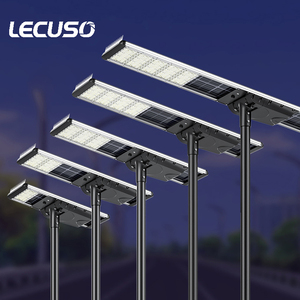
| LECUSO Solar | Monocrystalline Silicon | LiFePO4 Battery Pack | Smart MPPT Track | 15,000 Lm | IP65 / IK08 | ISO 9001, CE, IEC |
| GUOHUI Lighting | Mono-Silicon Glass | Lithium Storage Cell | Digital Controller | 8,500 Lm | IP65 | CE, RoHS, IP65 Cert |
| CHZ Lighting | High Efficiency Mono | LiFePO4 Industrial | PWM / MPPT Hybrid | 12,000 Lm | IP66 / IK09 | ISO 9001, TUV, CE |
| FirstEnergy Solar Systems | Monocrystalline Module | Deep-Cycle Lithium | Standard MPPT | 10,000 Lm | IP65 | UL Listed, ISO 9001 |
| Sokoyo Solar | Polycrystalline / Mono | Gel / Lithium Hybrids | Intelligent Control | 14,000 Lm | IP65 / IK08 | CE, RoHS, GS |
| PVI Solar Lighting | Mono-PERC Module | Lithium Iron Phosphate | High-Precision MPPT | 18,000 Lm | IP66 / IK10 | Buy American, CE, ISO |
| Greenshine New Energy | Monocrystalline Commercial | Lithium Battery Assembly | Adaptive Lighting MPPT | 16,500 Lm | IP65 | ISO 9001, UL Components |
| SEPCO Solar Lighting | Industrial Mono PV | Sub-Zero Gel / LiFePO4 | Custom Commercial MPPT | 20,000 Lm | IP66 | Buy American Compliant, ISO |
| Signify (Philips Solar) | High Efficiency PV | LiFePO4 Integrated | Smart IoT MPPT | 19,000 Lm | IP66 / IK08 | CE, UL, ISO 9001, ISO 14001 |
 ISO 9001:2015 Certified Manufacturing
 California Prop 65 Safety Standard
Bypass common commercial failure modes by inspecting core optoelectronic components, thermal management dissipation, and firmware algorithms.
Commercial perimeter security does not simply demand maximum raw lumens; it mandates precise directional flux distribution. Premium solar floodlights employ asymmetric Type III and Type V optical lenses crafted from high-transmittance optical-grade polycarbonate or tempered glass. This minimizes sky glow (Dark-Sky compliance) while eliminating hot spots and dark zones between lighting poles, ensuring clear visual identification for HD CCTV security cameras.
To balance continuous multi-night autonomy with high lux security illumination, advanced commercial floodlights utilize dual-mode 24GHz Microwave Radar sensors rather than basic Passive Infrared (PIR). Microwave sensors detect micro-movements through rain, fog, and dust. Automated firmware applies adaptive dimming (e.g., 30% baseline standby elevated to 100% full lumen output upon motion detection), conserving battery capacity without compromising threat deterrence.
Thermal degradation is the leading cause of premature LED output decay and battery BMS failure. Enterprise-grade floodlights feature housings cast from ADC12 die-cast aluminum alloy with integrated vertical heat-sink fins. Heat pipes isolate thermal emission from the LED engine away from the battery compartment, maintaining internal junction temperatures below 65°C even in desert climates.
Procurement specifications must account for minimum battery reserve days (Days of Autonomy). A system installed in northern latitudes requires higher storage margins than equatorial installations. Reliable sizing utilizes the autonomy equation:
Key technological vectors transforming off-grid outdoor lighting into smart city security assets.
Future commercial floodlights are transitioning from isolated fixtures to connected IoT endpoints. Integrated NB-IoT, LoRaWAN, and Zigbee mesh modules allow security teams to remotely track real-time battery state-of-charge (SoC), monitor solar harvest currents, adjust illumination schedules, and receive automated maintenance alerts via centralized Cloud dashboards.
By absorbing albedo radiation reflected from surrounding ground surfaces, concrete, or snow, bifacial double-glass solar panels boost total energy harvest by up to 25%. Furthermore, vertically integrated cylindrical pole solar wraps reduce wind resistance while preventing snow and debris accumulation on horizontal panels.
Next-generation perimeter lighting fuses high-lumen solar floodlights with low-power AI edge-computing cameras. These intelligent luminaires perform on-device facial recognition, license plate reading, and perimeter intrusion detection without needing external grid power or separate data cabling infrastructure.
Expert answers to common technical, installation, and procurement questions encountered during enterprise RFP processes.
Commercial solar floodlights utilize industrial ADC12 die-cast aluminum housings, high-efficiency monocrystalline solar panels (21-23.5% efficiency), Grade-A $\text{LiFePO}_4$ battery cells rated for 4,000+ cycles, and programmable MPPT controllers. Residential lights typically rely on plastic casings, low-grade polycrystalline panels, short-lived NMC batteries, and basic PWM controllers that fail after 12-18 months.
A premium Lithium Iron Phosphate ($\text{LiFePO}_4$) battery operated within optimal thermal bounds (-20°C to +65°C) and managed by an advanced Battery Management System (BMS) delivers a functional lifespan of 8 to 12 years (4,000 cycles at 80% Depth of Discharge) before requiring field replacement.
Yes. Professional solar security systems are engineered with a 3 to 7 day "Autonomy Reserve". Even during completely overcast days, high-efficiency MPPT controllers harvest diffuse light, while intelligent dynamic power management dims the LED output during non-critical hours to ensure uninterrupted perimeter illumination.
For hurricane-prone or coastal regions, systems must meet AASHTO wind load standards. Heavy-duty aluminum or hot-dip galvanized steel poles manufactured by certified suppliers are structurally engineered to withstand sustained winds up to 150–180 MPH.
Maximum Power Point Tracking (MPPT) controllers continuously adjust input voltage to extract maximum wattage from the solar array. MPPT systems deliver 15% to 30% higher energy conversion efficiency compared to Pulse Width Modulation (PWM) controllers, particularly during cold, overcast, or rapidly changing weather conditions.
Yes. Select manufacturers—such as Solar Lighting International—supply complete, US-engineered solar lighting systems fully compliant with Buy American Act (BAA) requirements for federal, municipal, and military infrastructure contracts.
Delivering utility-grade off-grid illumination systems backed by nearly two decades of engineering authority and global site deployments.
Since 2006, Solar Lighting International has engineered and manufactured industrial solar street, parking lot, and security floodlights. Our engineering team brings over 45 years of combined solar technology experience to every project deployment.
We do not sell off-the-shelf guesswork. Every enterprise procurement receives custom DIALux / IES light distribution simulations, guaranteeing exact foot-candle and lux uniformity compliance prior to manufacturing.
With regional support offices across North America, Latin America, and the Middle East, we provide turnkey delivery, field contractor certification, and comprehensive engineering support across 6 continents.
Connect directly with our senior sales engineering team for technical datasheets, IES files, wholesale factory pricing, and customized system design.