
Engineered for continuous commercial operation, high lumen efficiency, and complete off-grid autonomy across infrastructure, highway, billboard, and municipal applications.
An authoritative analysis of high-mast solar infrastructure engineering, photovoltaic conversion ratios, energy storage longevity, and supplier manufacturing capabilities.
High mast lighting systems—traditionally deployed at mounting heights between 15 meters and 40 meters (50 feet to 130+ feet)—represent the critical backbone for large-area illumination in seaports, intermodal freight yards, international airports, highway interchanges, and heavy industrial facilities. Historically dependent on energy-intensive High-Pressure Sodium (HPS) or Metal Halide fixtures tied to municipal high-voltage grids, global infrastructure operators are now rapidly transitioning to autonomous, off-grid High Mast Solar Lighting Systems. Driven by stringently managed capital expenditure budgets, stringent corporate ESG metrics, and the imperative for zero grid dependency during emergency power loss, high mast solar technology has advanced into a sophisticated domain of power electronics, dynamic optical beam shaping, and high-density energy storage.
Procuring high mast solar lighting systems demands rigorous technical evaluation far exceeding standard solar street light purchasing. Because luminaires installed atop 20m to 35m poles must cast uniform illuminance across thousands of square meters without structural failure or light pollution, municipal engineers and project procurement officers must assess four primary subsystem domains:
| Performance Domain | Legacy HPS High Mast | Standard Commercial Solar | Industrial Tier-1 High Mast Solar |
|---|---|---|---|
| Luminous Efficacy | 70 - 90 lm/W | 120 - 140 lm/W | 190 - 210 lm/W |
| System Autonomy (Days) | 0 Days (Grid Dependent) | 2 - 3 Rainy Days | 5 - 7 Days Continuous Autonomy |
| Wind Loading Capacity | Varies by Pole (100 MPH) | 120 - 140 MPH Rating | 180 MPH AASHTO Certified |
| Battery Cycle Life | N/A (Grid Tied) | 1,500 Cycles (Ternary Li) | 4,000 - 6,000 Cycles (Grade-A LiFePO4) |
| Maintenance Overhead | High (Annual Lamp Replacement) | Moderate (Panel Cleaning) | Ultra-Low (20-Year Shaft Life + Ground Winch) |
A comprehensive comparative review of leading international original equipment manufacturers (OEMs) and suppliers evaluated by engineering standards, manufacturing capacity, and quality control.
Lancaster, South Carolina, USA
Overview & Strengths: Founded in 2006, Solar Lighting International (SLI) is a world-class U.S. manufacturer specializing in commercial and industrial off-grid solar lighting systems. Holding ISO 9001:2015 certification and strict Buy American compliance, SLI is renowned for custom photometric engineering, high-output luminaires delivering up to 22,200 lumens per fixture (scalable up to 44,400+ lumens on single high masts), and poles carrying lifetime structural warranties engineered to withstand 180 mph hurricane winds.
Key Speciality: Custom Dialux photometric modeling, high-altitude commercial solar street and high-mast installations, integrated IoT smart control, and robust lithium iron phosphate (LiFePO4) storage systems for government, municipal, and airport projects.
Shanghai, China
Overview & Strengths: CHZ Lighting is an established global manufacturer focusing on high-power LED outdoor and flood lighting solutions. With extensive manufacturing acreage in Shanghai and Zhejiang, CHZ produces specialized high-mast solar floodlight systems configured for billboards, sports stadiums, ports, and freight terminals.
Key Speciality: Heavy-duty IP66 high-lumen floodlights, die-cast aluminum heat sinks, dual MPPT charge controllers, and customized structural brackets for multi-module high mast arrays.
Jiangsu, China
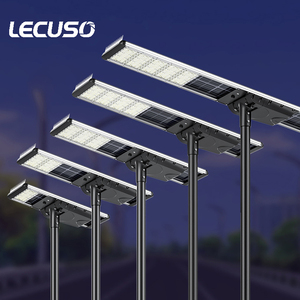
Overview & Strengths: LECUSO is a large-scale OEM factory known for integrated "All-in-One" and "All-in-Two" solar street and flood lighting lines. Their facility houses automated SMT lines and robotic solar panel assembly, delivering high-volume production for municipal road networks and industrial park developments globally.
Key Speciality: Modular solar street light heads ranging from 30W to 150W, automated battery pack assembly, and cost-effective bulk OEM manufacturing.
Yangzhou, Jiangsu, China
Overview & Strengths: GUOHUI is a recognized manufacturer of outdoor steel lighting structures, high mast poles, and integrated solar perimeter floodlights. Operating dedicated hot-dip galvanizing plants, GUOHUI controls the end-to-end production of steel high mast shafts and solar mounting hardware.
Key Speciality: 15m to 35m polygonal steel high mast poles, motorized lowering ring mechanisms, and long-lifespan MPPT perimeter floodlight systems.
Omaha, Nebraska, USA
Overview & Strengths: Valmont is a global leader in infrastructure engineering and pole structural design. Their high mast solar division combines heavy-duty steel engineering with retrofitted industrial solar arrays, supplying airports, highway authorities, and mining facilities across North America and Europe.
Key Speciality: Structural stress calculations, heavy-duty lattice and tubular high masts, extreme wind loading compliance, and utility-scale solar integration.
Eindhoven, Netherlands
Overview & Strengths: As the global leader in lighting technology, Signify offers high-efficiency Gen2 solar street and flood lighting systems under the Philips brand. Their systems feature proprietary optical lenses and smart software platforms for dynamic light management.
Key Speciality: High flux density LED modules, Philips Interact IoT management software, and global distribution network capabilities for public tenders.
Lake Forest, California, USA
Overview & Strengths: Greenshine specializes in custom solar outdoor lighting systems for commercial parking lots, public parks, and high-security perimeter applications. They offer customized commercial systems utilizing gel and lithium battery configurations tailored to North American municipal requirements.
Key Speciality: Municipal solar street lights, decorative commercial solar poles, and dark-sky compliant outdoor light fixtures.
Stuart, Florida, USA
Overview & Strengths: Operating for over three decades, SEPCO is a pioneer in commercial off-grid solar lighting. SEPCO designs heavy-duty commercial solar structures engineered specifically for high hurricane wind zones in coastal regions.
Key Speciality: Split-system industrial solar arrays, marine-grade aluminum fixture housings, and robust wind-load engineered pole assemblies.
Agen, France
Overview & Strengths: Fonroche is a dominant European off-grid solar lighting manufacturer focused on highway and major arterial road electrification. Their proprietary Power3 technology ensures 365 nights of uninterrupted illumination regardless of geographical location.
Key Speciality: Fast-installation solar street light systems, NiMH high-temperature battery integration, and European highway infrastructure deployments.
North Rhine-Westphalia, Germany
Overview & Strengths: Bischoff & Söhne is a specialized European engineering manufacturer known for heavy industrial high-mast towers, automated lowering winches, and custom solar module brackets for industrial ports and rail switchyards.
Key Speciality: High-capacity mechanical winch engineering, heavy structural steel shafts, and extreme-environment European industrial deployments.
Key engineering innovations and structural evolutions shaping high-mast solar lighting procurement over the next decade.
Traditional horizontal flat solar panels on top of high masts create heavy wind-sail loads (EPA). Future high-mast designs are shifting toward vertical cylindrical solar wraps and high-efficiency bifacial N-Type TOPCon panels. Vertical PV integrated directly along the pole upper section reduces wind load by up to 60%, sheds snow automatically, and captures ambient ground albedo reflection to increase power harvesting by 15% to 25%.
High mast systems are evolving into smart-city digital communication hubs. Integrated with LoRaWAN, NB-IoT, and Zigbee wireless mesh networks, modern high mast systems provide real-time diagnostic reporting on battery state-of-health (SoH), solar charge efficiency, and luminaire temperature. Dynamic radar dimming algorithms automatically adjust light output from 30% to 100% based on traffic flow or worker presence, extending battery autonomy during severe overcast weather.
Temperature extremes remain the primary point of failure for outdoor energy storage systems. Procurements for extreme hot (Middle East/North Africa) or sub-zero climates (Nordic/North American regions) are specifying smart BMS enclosures with micro-thermoelectric cooling and solid-state heat pipes. Additionally, Lithium Titanate (LTO) batteries are emerging for heavy industrial applications requiring operational performance between -40°C and +65°C with over 15,000 cycle lifespans.
Environmental light pollution regulations enforced by the International Dark-Sky Association (IDA) now heavily dictate tender requirements. Modern high mast luminaires utilize strict zero-uplight (U0) optical shields and Warm CCT (2700K - 3000K) LED chips to prevent skyglow and protect local wildlife, while using engineered micro-lenses to channel 98% of emitted light precisely onto designated target ground surfaces.
Maintaining luminaires mounted on 30-meter high masts traditionally requires expensive boom trucks and site disruption. The standard for industrial procurement now demands automated internal electrical winch systems. Operators can lower the entire luminaire ring and solar engine assembly to ground level in under 5 minutes using a portable remote control, eliminating hazardous high-altitude maintenance work entirely.
For critical infrastructure like airport runways and seaport docks where zero downtime is permissible, dual-input hybrid solar engines are replacing pure off-grid setups. The system operates on 100% free solar energy during normal conditions, but features an automatic, microsecond solid-state transfer switch to auxiliary AC grid power if battery storage drops below a 15% safety threshold during historic 10-day storm events.
Combining nearly two decades of American engineering heritage with certified quality management standards to deliver uncompromised commercial lighting solutions.

Strict quality control processes across design, manufacturing, assembly, and testing ensure zero-defect production for every project component.

US-engineered systems meeting Buy American standards and California Proposition 65 safety regulations, trusted by federal agencies and municipalities.
Structural light poles and heavy mast arms engineered to withstand Category 5 wind speeds with lifetime structural pole warranties.
Every proposal includes custom Dialux photometric rendering reports, proving foot-candle coverage and light distribution before purchase.
Technical answers to key engineering, installation, and procurement queries encountered during commercial solar lighting project planning.
A: Sizing high mast solar systems requires calculating total continuous power draw (Watts) multiplied by operational run hours per night to establish total Watt-hours (Wh) needed per day. This figure is adjusted for geographical peak sun hours (PSH) during the winter solstice, MPPT controller efficiency (typically 98-99.5%), and inverter/driver thermal losses. Battery capacity is then sized to provide a minimum of 4 to 7 continuous days of autonomy (Rainy Day Reserve) without exceeding an 80% Depth of Discharge (DoD) to protect LiFePO4 battery lifespan. Custom Dialux photometric and solar radiation software simulations are performed to ensure 100% dusk-to-dawn reliability.
A: Effective Projected Area (EPA) is a mathematical calculation measuring the drag force created by wind blowing against surface areas (solar panels, luminaires, brackets, and battery boxes) mounted on a pole, multiplied by their aerodynamic drag coefficients. Because high mast solar systems feature large solar arrays mounted at heights of 50 to 120+ feet, the high overturning moment forces placed on the steel shaft base and anchor bolts are massive. High mast poles must be structurally engineered in accordance with AASHTO wind load standards to withstand local maximum gust velocities (e.g., 180 mph) without mechanical structural fatigue or failure.
A: LiFePO4 (LFP) chemistry offers significant technical advantages for industrial high-mast applications. First, LFP provides extreme thermal stability, avoiding thermal runaway fire risks up to 60°C (140°F). Second, LFP delivers an exceptional cycle life of 4,000 to 6,000 complete charge/discharge cycles at 80% DoD—equating to 10-15 years of daily service—compared to only 500-800 cycles for traditional Gel/Lead-Acid batteries or 1,200 cycles for Ternary NCM Lithium. Furthermore, LFP is non-toxic, free of cobalt, and features a high energy density with low self-discharge rates.
A: Maximum Power Point Tracking (MPPT) controllers utilize dynamic electronic DC-to-DC conversion algorithms to continuously adjust the solar panel's operating point, capturing maximum solar power regardless of solar irradiance intensity or temperature fluctuations. MPPT controllers are 20% to 35% more efficient than basic Pulse Width Modulation (PWM) controllers, which essentially act as a simple switch connecting the panel directly to the battery. In commercial high mast systems where maximizing solar harvesting from limited panel area is essential, digital MPPT controllers are mandatory.
A: A high mast motorized lowering mechanism consists of an internal heavy-duty stainless steel cable system, self-sustaining winch assembly, and multi-core electrical disconnect plug located inside the pole base. When maintenance or optical inspection is required, a technician connects a portable electric drive motor to lower the entire luminaire ring and solar panel mounting carriage down to ground level safely. This eliminates the necessity for heavy high-reach crane access, ensures technician safety, and dramatically decreases long-term maintenance costs.
A: Essential international certifications for high mast solar procurement include: ISO 9001:2015 (Manufacturing Quality Management), ISO 14001 (Environmental Management), CE, UL 1598 (Luminaires), UL 2271/UL 1973 (Lithium Batteries), IP65/IP66 Waterproof & Dust Ingress Protection, IK10 Impact Resistance, and AASHTO structural certification for wind loading. For U.S. municipal and federal projects, verification of Buy American compliance and IDA Dark-Sky Association compliance should also be mandated.
Contact our sales engineering team today to request custom Dialux photometric reports, technical specifications, structural wind loading analyses, and direct manufacturer pricing.