1. Executive Procurement Overview: The Shift to High Lumen Commercial Solar LED Area Lights
Municipalities, civil engineering consultants, commercial real estate developers, and military logistics infrastructure planners are under accelerating pressure to modernize exterior lighting. Traditional High-Pressure Sodium (HPS) and Metal Halide (MH) luminaires are rapidly becoming obsolete due to unsustainable energy draw, frequent lamp replacements, poor Color Rendering Index (CRI < 30), and substantial carbon footprints. Furthermore, extending conventional utility grid infrastructure—involving asphalt trenching, conduit laying, step-down transformer installations, and monthly utility tariffs—frequently accounts for 60% to 70% of total project capital expenditure.
High Lumen Commercial Solar LED Area Lights represent a fundamental shift in off-grid infrastructure design. Modern commercial solar lighting systems do not merely match the performance of 400W–1000W legacy grid-tied fixtures; they surpass them in luminous efficacy (delivering up to 210 lumens per watt at the LED chip level), optical directional control, operational longevity, and resilience against utility power outages.
The Information Gain Advantage for Procurement Teams
When evaluating high-output solar area lights, procurement managers must move beyond misleading "raw LED lumen rating" claims often found in consumer-grade equipment. True commercial compliance requires auditing system-level lumens (delivered after optical lens and thermal junction losses), daily battery depth of discharge (DoD) protocols, ambient temperature derating factors, and Effective Projected Area (EPA) structural stability under severe wind events.
Solar Lighting International, Inc. (SLI) has engineered commercial-grade off-grid area lighting solutions since 2006. With over 45 years of combined solar engineering experience, SLI designs systems engineered for extreme operating environments—ranging from the high ambient heat of Middle Eastern deserts to the hurricane-prone coastal corridors of North and Central America.
Trusted by Global Enterprise & Governmental Partners





2. High Lumen Commercial Solar LED Area Light Product Systems
SLI offers versatile off-grid architecture configurations designed specifically for high-lumen, high-mounting-height applications (ranging from 6 meters to 14 meters). Below are our core enterprise product categories engineered for commercial parking lots, municipal roadways, logistics hubs, and perimeter defense networks.
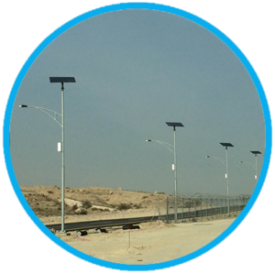
Commercial Solar Street Lights
Engineered for highway interchanges and municipal thoroughfares. Up to 22,200 lumens per arm with IESNA Type II and Type III distribution patterns.
Send an Inquiry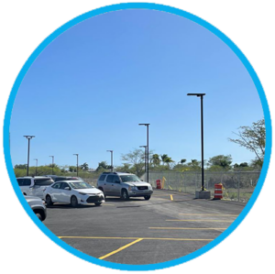
Solar Parking Lot Lighting
High-output square and rectangular area lighting profiles designed to eliminate dark spots in retail complexes, ports, and industrial yards.
Send an Inquiry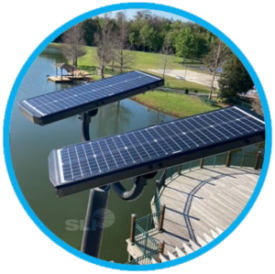
All-In-One Solar LED Systems
Integrated PV panel, LiFePO4 battery, and LED engine within a single aerodynamic housing. IDA Dark-Sky Compliant with zero uplight (ULOR=0%).
Send an InquiryTechnical Specification Comparison Benchmark
The following engineering data table highlights the key performance metrics across SLI's flagship commercial solar area lighting tiers:
| System Model Tier | Delivered Lumens | PV Panel Array (Wp) | LiFePO4 Storage Capacity | Autonomy Rating | Optics & Distribution | Wind Rating (EPA) |
|---|---|---|---|---|---|---|
| SLI-AL-7400 | 7,400 lm | 120W - 150W Mono | 12.8V / 40Ah (512Wh) | 5 - 7 Nights | Type II / Type III | 160 MPH |
| SLI-AL-14800 | 14,800 lm | 260W - 320W Mono | 12.8V / 80Ah (1,024Wh) | 5 - 7 Nights | Type III / Type IV | 175 MPH |
| SLI-AL-22200 | 22,200 lm | 380W - 450W Mono | 25.6V / 60Ah (1,536Wh) | 5 - 7 Nights | Type III / Type V (Area) | 180 MPH |
| SLI-AL-44400 (Dual Arm) | 44,400 lm | Dual 380W Mono Array | 25.6V / 120Ah (3,072Wh) | 5 - 7 Nights | Type V Square / Perimeter | 180 MPH (Heavy Duty Pole) |
3. Future Procurement & Technology Trends (2026–2035)
As global municipal and corporate procurement standards shift toward strict ESG (Environmental, Social, and Governance) benchmarks, the high-lumen solar LED area lighting industry is evolving rapidly. Buyers who understand these technical macro-trends gain long-term architectural flexibility and lower lifecycle maintenance costs.
Trend 1: Smart City IoT Telemetry & Grid-Interactive Dynamic Dimming
Future-proof commercial solar area lights are no longer static, standalone illumination posts. Modern installations feature integrated IoT nodes operating via Cellular (NB-IoT / LTE-M) or mesh networks (LoRaWAN). Controllers monitor panel charging current, battery health metrics, ambient thermal levels, and fixture operation in real time. Advanced MPPT firmware supports dynamic profile dimming—automatically adjusting lumen output based on foot traffic, motion sensing, or time-of-night schedules to stretch battery autonomy through prolonged storm windows without complete blackout conditions.
Trend 2: Next-Generation LiFePO4 Chemistry & Thermal Management Advances
Legacy AGM/Gel lead-acid batteries are now entirely obsolete in high-performance solar specifications. The market baseline has shifted strictly to Lithium Iron Phosphate ($\text{LiFePO}_4$). Engineered for over 4,000 deep discharge cycles at 80% Depth of Discharge (DoD), $\text{LiFePO}_4$ chemistry offers unmatched thermal stability, eliminating the thermal runaway risks associated with traditional NMC battery cells. Future developments are focusing on internal solid-state heating elements that allow seamless battery charging even under severe sub-zero ambient conditions (down to $-30^\circ\text{C}$).
Trend 3: IDA Dark-Sky Compliance & Spectral Tuning for Biodiversity
Light pollution mitigation is now mandatory across many federal, state, and local park jurisdictions. High lumen area lights are transitioning toward full IDA (International Dark-Sky Association) compliance, requiring 0% Uplight Output Ratio (ULOR=0) and precise cutoff optics. Additionally, spectral tuning (utilizing 2200K to 3000K low-blue LED arrays) is increasingly specified near coastal zones to preserve wildlife corridors and protect sea turtle nesting areas.
Trend 4: Circular Economy Architecture & Field Modular Serviceability
Procurement officials are rejecting sealed, single-use light fixtures that require entire replacement upon component failure. Future-ready commercial solar lights incorporate modular toolless design: separate optical light engines, hot-swappable battery drawers, and standardized plug-and-play charge controller boxes. This guarantees that systems installed today can be upgraded with higher-efficiency solar panels or upgraded battery packs 10 to 15 years down the line without replacing the foundation, pole, or structural brackets.
4. High Lumen Solar Area Lighting: B2B Procurement FAQ
Below are detailed technical answers to the most common queries submitted by civil engineers, utility directors, and corporate purchasing officers when specifying commercial off-grid solar LED area lights.
Accurate solar system sizing requires evaluating daily energy consumption against regional solar irradiation data (Peak Sun Hours, or PSH). The mathematical framework follows this sequence:
- Daily Energy Calculation ($E_{\text{daily}}$): If a fixture operates at an average effective load of 60W for 12 hours, total night consumption is: $$\text{Power Consumption} = 60\text{W} \times 12\text{h} = 720\text{Wh/night}$$
- Battery Storage Sizing ($C_{\text{battery}}$): To guarantee 5 days of rainy-day autonomy at a safe 80% maximum Depth of Discharge ($\text{DoD} = 0.8$): $$C_{\text{battery}} = \frac{720\text{Wh} \times 5\text{ days}}{0.8} = 4,500\text{Wh}$$
- Solar Panel Sizing ($W_{\text{panel}}$): Assuming a worst-case winter solar availability of 3.5 Peak Sun Hours and a combined system efficiency factor ($\eta = 0.85$ accounting for MPPT and wiring losses): $$W_{\text{panel}} = \frac{720\text{Wh}}{3.5\text{ PSH} \times 0.85} \approx 242\text{Wp}$$
SLI engineering over-specifies both PV capacity and battery bank sizing to prevent deep discharge strain, ensuring a 10-to-12-year battery operating life.
While the upfront hardware cost of a solar pole assembly (including PV module, battery storage, and MPPT controller) is typically higher than a standard grid-tied fixture head, the total installed cost of solar is dramatically lower. Grid-tied lighting requires extensive trenching ($50–$150 per linear foot), underground conduit run installation, copper wiring, junction boxes, transformer drops, and municipal permitting. In perimeter or parking lot projects exceeding 200 feet from a utility hookup, off-grid commercial solar LED area lights deliver immediate capital savings of 25% to 50% on day one, combined with $0 monthly electric utility costs for the lifespan of the equipment.
High-lumen solar systems feature large PV panels that increase the total Effective Projected Area (EPA) of the structure. Standard light poles will fail or bend under high wind loads if not properly structural-engineered. SLI solar light poles are manufactured from high-strength structural aluminum (6061-T6) or heavy-gauge galvanized steel, engineered to withstand continuous wind forces up to 180 MPH (289 km/h) in full compliance with AASHTO wind load standards. For coastal installations, marine-grade anodized finishes and stainless steel (316 grade) hardware prevent salt-air galvanic corrosion.
Raw LED lumens represent the theoretical light output produced by the LED chips under pristine laboratory junction temperatures ($25^\circ\text{C}$). However, real-world luminaire performance is subject to optical lens transmission losses, thermal junction heat buildup, and driver efficiency drops. SLI reports certified delivered lumens measured via goniophotometer testing according to IES LM-79-08 standards. This ensures that a fixture rated at 22,200 lumens delivers true photometrically validated foot-candles on the pavement surface.
Under the Buy America Act (BAA) and Build America, Buy America (BABA) provisions, public infrastructure projects funded by federal grants (such as DOT roadway lighting, federal parkways, and military installations) require lighting systems engineered and manufactured within the United States. SLI provides Buy American Compliant complete solar street light poles and parking lot lighting systems, complete with certified origin documentation for smooth project bidding and compliance auditing.
5. Enterprise Advantages & Manufacturer Credibility
Solar Lighting International, Inc. stands as an industry benchmark in commercial solar outdoor lighting. We combine technical innovation with uncompromising manufacturing standards to deliver reliable off-grid solutions worldwide.

Solar Lighting International, Inc.
Lancaster, South Carolina, USA • Established 2006For nearly two decades, Solar Lighting International has designed, engineered, and exported high-performance commercial solar lighting equipment for municipal infrastructure, utility networks, industrial sites, and private developments across North America, Latin America, the Middle East, and worldwide.
Turnkey Engineering Support: From Photometric Analysis to Site Commissioning
At Solar Lighting International, we do not simply sell off-the-shelf light fixtures. Our engineering team partners with site developers, civil engineers, and procurement directors from day one to deliver complete turnkey support:
- Custom Photometric Engineering (Dialux Simulations): We analyze your exact site layout, mounting heights, and required foot-candle levels to produce comprehensive photometric point-by-point calculations, ensuring IESNA uniformity compliance before procurement.
- Regional Solar Autonomy Auditing: Using multi-year NASA climate irradiance data, we custom-size PV wattage and battery Ah capacities tailored to your project's worst-month solar conditions.
- Contractor Installation Coordination: Supported by an extensive network of certified electrical contractors, SLI supports seamless installation, pole footing verification, and system commissioning anywhere around the world.